


 Places of the Salernitana Medical School Artistic Historic
Monumental complex of San Pietro a Corte
- Description
- Event
- News
- Gallery
- Contacts
- Map
- Opening hours
- Itineraries
Historical background
The church of San Pietro a Corte was built in the 8th century AD on the remains of a Roman bath building that had already been reused as a place of worship and burial in the early Christian era.
It was in this area that Arechi II had a chapel dedicated to Saints Peter and Paul built as an annex to his great Salerno mansion, to be used as a ‘Court’ chapel and reception hall.
As the centuries passed, the building underwent numerous and profound transformations. The princely palace, which reached almost to the sea, was remodeled several times until it was incorporated into various private dwellings. The rooms of the palatine chapel, however, were used for public purposes throughout the medieval period.
After the Norman conquest in 1076 the underground (hypogeum)space housed an oratory, enriched with splendid frescoes of Byzantine influence, dating from the late 12th century.
Throughout the Norman-Swabian period, the upper hall was used for meetings of the town parliament and, later, for the graduation ceremonies of the Salernitan Medical School. It is likely that San Pietro a Corte also hosted some of the school’s lectures in the rooms of the ‘hypogeum where, among the subjects depicted in the frescoes, the presence of St. Catherine of Alexandria, patron saint of the wise, recurs.
The upper hall was used for the graduation ceremonies of the Salerno Medical School.
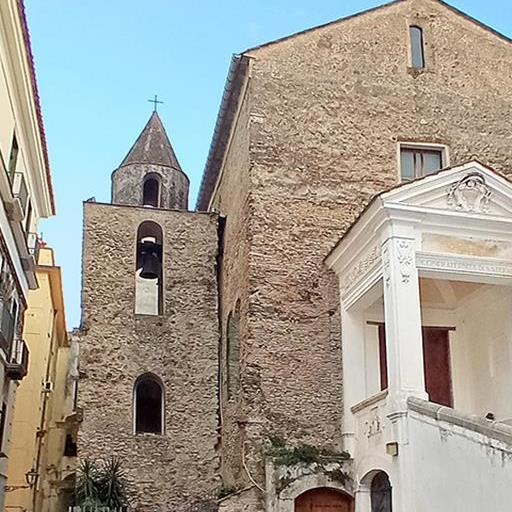
Between the twelfth and sixteenth centuries the complex was joined by the campanile still visible today, perhaps built in place of the original one from the Lombard period.
In the 16th century San Pietro a Corte obtained the title of abbbey commendatory (‘in concession’), undergoing numerous transformations and embellishments: the floor of the upper church was rebuilt, the apse from square became semicircular, in place of the external loggia the present staircase of access to the chapel (whose original entrance was only from inside the palace) was built, then restored in the 18th century.
The Pignatelli family, which had become the owner of the structure, was responsible for the restorations and transformations of the 18th century, with the creation of new altars and the insertion of canvases and paintings. In the same period a small chapel known as the Sant’Anna chapel
was built on the north side of the building, at street level.
With the Unification of Italy the abbey of San Pietro a Corte was suppressed and the Pignatelli princes decided to sell the structure, which slowly fell into disuse. During World War I it was used as a military depot, and in 1939 it was finally given to the confraternity of Santo Stefano.
In the 1970s, the Superintendency undertook complex recovery and restoration work on the upper chapel, the underground rooms and the chapel of St. Anne, which were reopened to the public in 2010.
The complex today
Today the complex of San Pietro a Corte stands as a true narrative of the different historical eras experienced by the city of Salerno. A place that shows the alternation of the centuries through the vertical reading of structures that differ in age, styles and functions.
The monument is characterized by four distinct buildings:
- a vast underground “hypogeum” with traces of Roman baths from the imperial age (1st-2nd centuries AD) and an early Christian place of worship and burial (5th-7th centuries), later to become an oratory in Norman times, with 12th-century frescoes.
- The former palatine chapel and throne room of Arechi II (8th century AD) became throughout the medieval period the seat of the city parliaments and then of the Salerno Medical School, finally badia of St. Peter’s Court between the 16th and 19th centuries.
- The campanile leaning against the complex, built between the 12th and 16th centuries in place of the earlier Lombard work.
- The eighteenth-century Chapel of Saint Anne.
The layered architecture of San Pietro a Corte preservesfrescoes, marbles, inscriptions, canvases and paintings that make one feel the passage of time. In this place, nestled in the ancient heart of Salerno, it is indeed possible to experience the charm of stories resurfaced from a distant past that marked the life of the city.
To be discovered
- The Hypogeum
.
In the lower room of San Pietro a Corte, or hypogeum, are traces of Roman baths from the Imperial age and a later place of worship and burial used by the Christian communities of Salerno. When Arechi had his palace built in the late 8th century AD, he fortified the walls and pillars so that they could support the weight of the upper floors, making a new attic that became the floor of the church above. The whole hypogeum, in fact, became a crypt of the palatine chapel and was later used as an oratory and study room, enriching it with new frescoes dating from the 12th century.
- The frigidarium
.
In the compartment of the frigidarium of the baths is a tomb belonging to a certain Socrates, vir spectabilis of Greco-Byzantine origin and bearing the following epitaph: “Under the consulship of our lord Anastasius perpetual Augustus on the fourteenth day before the kalends of December, here rests in peace Socrates, magistrate of high rank who lived for forty-eight years.”
- The high altar
.
On the high altar of the Palatine Church is a painting depicting Our Lady in Glory between Saints Peter and Paul, St. Cyrus, a physician and hermit, and St. John the Soldier, her disciple. Kneeling in prayer is Decio Caracciolo, abbot until 1613, who had commissioned the painting, attributed to Decio Tramontano.
Curiosities / Need to know
- Arechi II and the new role of Salerno
.
In 774, with Charlemagne’s descent into Italy and the surrender of Pavia, the capital of Langobardia maior, Duke Arechi II moved his court from Benevento to Salerno proclaiming himself princeps and last bastion of the Lombard peoples in the Peninsula.
Arechi II died in 787 after promoting the reinforcement of all the city walls and the ancient Byzantine Castle, as well as the construction of his grand new palace and the palatine chapel of St. Peter’s Court.
- The flood in the harbor
.
The Roman baths on which the private chapel of Arechi II was built stood near the harbor of ancient Salernum, in an area that between the late 4th and early 5th centuries AD was completely destroyed by a flood. In addition to the presence of river pebbles and clay, the flood is documented by an’inscription that reports of a certain Arrio Mecio Gracchus patronus who had financed the redevelopment of the city after the destruction.
- The decline of St. Peter’s Court
.
In the late nineteenth century, the complex of St. Peter’s Court lost many of its functions and gradually fell into disuse. During World War I the building became an ammunition depot, while the rooms in the chapel of St. Anne were occupied by a blacksmith’s store and then a coal store. Only at the end of the last century was the entire complex excavated, restored and recovered to be reopened to the public.
Loading…
| Monday | not accessible | ||
| Tuesday | 10:00 – : | : – 18:00 | |
| Wednesday | 10:00 – : | : – 18:00 | |
| Thursday | 10:00 – : | : – 18:00 | |
| Friday | 10:00 – : | : – 18:00 | |
| Saturday | 10:00 – : | : – 18:00 | |
| Sunday | 10:00 – : | : – 18:00 |
Cost: Free
Social network:
facebook Soprintendenza Archeologia Belle Arti e Paesaggio di Salerno e Avellino
Instagram: Sabap_Salerno
X / twitter: @sabap_salerno
Places of the Salernitana Medical School Artistic Historic