


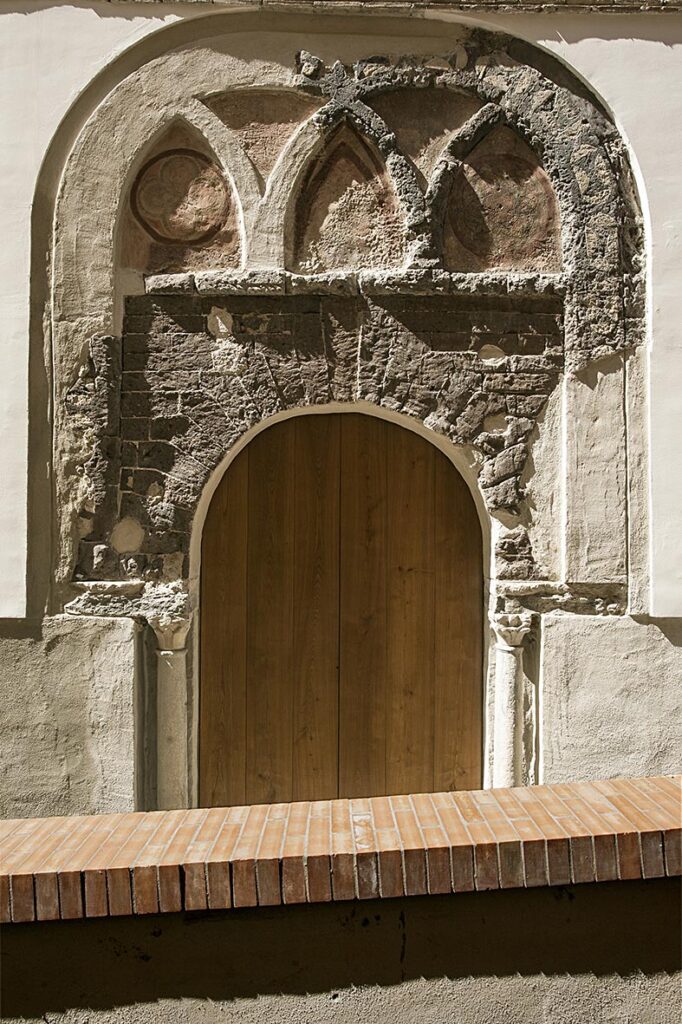
 Fruscione Palace Palaces and Squares Palazzo Fruscione, Vicolo Adelberga, Salerno, SA, Italia
We sail on fragile vessels – Meeting with Nobel Laureate Devoret
Two special meetings will accompany the closing (Tuesday, June 2) of the widespread exhibition "Infiniti Mondi. Journey in the Poetics of Fabrizio De André," which since last March 21, in Salerno, has seen more than one hundred and sixty works on display, between Palazzo Fruscione and in a diffuse itinerary among evocative locations in the old city center, recounting the poetic relevance of the themes that the Genoese singer-songwriter gave to the short century.
- Event
- Place
- Date/Hours
- Tickets
- Map
- Related Events
- Editions
Tutti
Tempi Moderni
Navigate on fragile vessels
Meeting with the Nobel Prize Devoret
Two special meetings will accompany the closure (Tuesday 2 June) of the widespread exhibition “Infiniti Mondi. A journey into the poetics of Fabrizio De André”, which from last 21 March, in Salerno, has seen over one hundred and sixty works on display, between Palazzo Fruscione and in a diffused path between suggestive locations of the ancient center, tell the poetic relevance of the themes that the Genoese singer-songwriter gave to the short century.
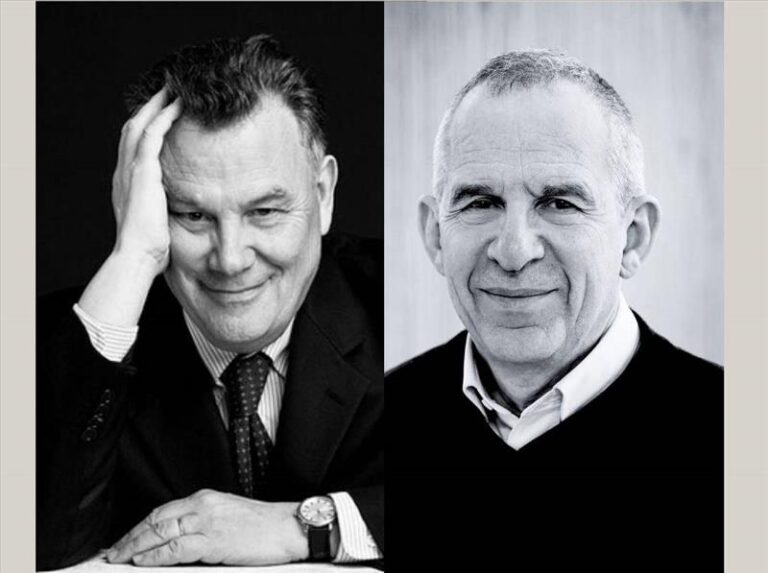
Francesco Casetti, Sterling Professor of Humanities and Film and Media Studies of Yale University and Michel Henri Devoret, Professor Emeritus of Applied Physics at Yale University, Nobel Prize for Physics in 2025, through a rare and original dialogue will bind two fields only seemingly far away: cinema, art of vision and imagination, and physics, science of light of time and matter.
In the frame of Palazzo Fruscione, within the tenth edition of the Tales of the Contemporary, “We live on fragile vessels” made as rich and articulated appendage of the exhibition “Infiniti mondo. Journey into the poetics of Fabrizio De André”, they will reason – Monday 1 June at 19.00 – around the possible worlds that open when imagination and knowledge mirror each other. If cinema is born from the optical, mechanical and perceptive principles, it is also true that, over time, it has been able to transform physics into a story, making visible complex concepts such as space-time, gravity, relativity and paradoxes of the real. Cinema can show in images, sounds and words the multiplicity of particle trajectories, black holes, the granularity of matter showing how difficult it is to imagine. It emerges, thus, an unpublished cross between scientific knowledge and humanistic culture, between what we see on the screen and what science helps us to think. The meeting will be introduced by the president of the Associazione Tempi Moderni, lawyer Marco Russo while greetings will be entrusted to the Magnificent Rector of the University of Salerno, Virgilio D’Antonio.
Casetti is Sterling Professor of Humanities and Film and Media Studies at Yale University. He was Visiting Professor at l’ University Paris 3 – Sorbonne Nouvelle, l’ University of’Iowa and l’ Harvard University. He also obtained research grants (Fellowships) at l’ University of Otago (New Zealand), Bauhaus University of Weimar and Freie Universität in Berlin. He was awarded the prestigious chair “Chair of Italian Culture” reserved for illustrious scholars at l’ University of Berkeley. He is author of six books, translated (among other languages) in French, Spanish, Czech and Korean; he is also co-author of two books, curator of over ten books and special numbers of magazines and author of over sixty essays. His early studies focused on the semiotics of the cinematographic and audiovisual text, focusing in particular on the dynamics of the spectator’s involvement (“I take a look. The film and its viewer”, published in English by Indiana University Press in 1998, or. 1986) and on the communicative negotiation (Communicative Negotiations in Cinema and Television, Milan, 2002). Afterwards, Casetti directed his research towards a historical media criticism. In the essay “L’occhio del Novecento. Cinema, experience, modernity” analyzed the way cinema has welcomed and redefined the anxieties, traumas and psychological and social needs of the first half of the 20th century. His next book, “The Galaxy Lumière. Seven key words for the cinema that comes”, proposes a ’ wide reconnaissance on the fate of cinema in the ’ digital era, redefining it through its relocation in new spaces and on new devices, beyond the traditional cinema room. His most recent volume, “Screening Fears. On Media, Threat, and Defense (Zone Books, 2023), traces a genealogy of screens intended as protection and exposure zones from the 18th century (with phantasmgories) to modern digital media. Casetti also wrote extensively (and continues to do so) about the history of cinema theories. Among these publications are Theories of Cinema. 1945-1990 (Texas University Press 1999, or. 1993) and l’ anthology Early Film Theories in Italy. 1896-1922 (Amsterdam University Press, 2017). He is currently carrying out a research project on the fears aroused by cinema in his early decades of life (the so-called intercom positions), examining the arguments raised by medical, religious, social and political speeches against the moral and physical dangers of the cinema. He is also co-director of an international research project on the disinformation and dynamics of “camere dell’’ eco&” (echo-chambers), with a specific focus on the historical roots of these phenomena.
Devoret, along with John Clarke and John M. Martinis, conducted a series of historical experiments in the mid-1980s (between 1984 and 1985). Building an electronic circuit consisting of superconductive elements, the research team has demonstrated for the first time that the bizarre laws of quantum mechanics, long confined exclusively to the microscopic world of elementary particles and atoms, could also manifest on scale “ macroscopic ”, or in electrical circuits large enough to be held in hand. By controlling and measuring the phenomena generated by passing a current into the circuit, the three scientists tested both l’ existence of the ’ macroscopic tunnel effect, and the fact that l’ energy all’ within these circuits is quantized (that is, the system absorbs or emits only well defined quantities and discrete energy). This pioneering transition from microscopic to macroscopic has laid the foundations of quantum (the physics of quantum circuits), opening the street all’ modern qubit engineering and processors for today’s quantum computers.
The event will be preceded, Sunday 31 May at 19.00 at Palazzo Fruscione, from the meeting with the photographer Guido Harari, among the protagonists of the exhibition. The meeting will be divided in two moments. It begins with the screening of “Sguardi randagi” by the director Daniele Cini, the documentary that tells the life and l’ art of Harari, one of the greatest contemporary Italian photographers. Following Giovanni Fiorentino, among the leading photography scholars in Italy, as well as President of the Italian Society for the Study of Photography, will be in dialogue with the photographer and the director in an evening that will take us by hand in the history of some of the most iconic images of the protagonists of the contemporary music scene, from Lou Reed to David Bowie, from Frank Zappa or Kate Bush to the shots dedicated to the protagonist of the exhibition of Modern Times, Fabrizio de André. The meeting will be introduced by journalist Valeria Saggese.
The exhibition Infiniti Mondi. Travel in the poetics of Fabrizio De André, is organized and curated by the Associazione Tempi Moderni in collaboration with the Municipality of Salerno, the Superintendency Archeology, Fine Arts and Landscape of Salerno and Avellino, the State Archives of Salerno, the Fondazione Ebris, the Fondazione della Scuola Medica Salernitana, the Teatro “Giuseppe Verdi” of Salerno, the Court of Appeal and the Attorney General of Salerno, the University of Studies. It is promoted and supported by Campania Region, Municipality of Salerno with the Teatro “Giuseppe Verdi” and the Chamber of Commerce I.A.A. of Salerno. The Navighiamo festival on fragile vessels is conceived and organized by the Associazione Tempi Moderni, promoted and supported by Regione Campania, Comune di Salerno with the Teatro “Giuseppe Verdi” and the Chamber of Commerce I.A.A.A. of Salerno. With the patronage of Region Campania, Province of Salerno, Municipality of Salerno, Chamber of Commerce I.A.A. of Salerno, Confindustria Salerno, University of Salerno, Fondazione Carisal, Order of Journalists of Campania and, for the Sounds section of the Review, Assomusica. With the contribution of: Allianz di Parrilli e Sanfilippo, Banca Campania Centro, Centrale del Latte Spa, Con-tra Spa, De Luca srl, Fondazione Carisal, Fondazione Ebris, Fondazione Saccone, Fondazione Tosi, Metoda Finance srl, Project Finance 4.0, Ritonnaro Spa, Sada Spa. Technical sponsors: Boccia Industria Grafica spa, De Cesare Viaggi, Del Basso parquet, Guardian Srl, Marsia, Studio Pedone and Tomeo Architet’s Lab, Santoro Grafica srl. In collaboration with: Agesci Gruppo Scout Salerno 10, Associazione culturale Lab 147, Cerzosimo studio e visual, Festival De André di Brescia, Festival book open, Fondazione Saccone, Foto Diego, Feltrinelli Librerie, Ordine dei Journalsti della Campania, Sony Music, Teatro “Giuseppe Verdi” Salerno, Università degli Studi di Salerno. Media partner: Campania Life, RCS, Zona RCS, Salerno News24.
Fruscione Palace Palaces and Squares Palazzo Fruscione, Vicolo Adelberga, Salerno, SA, ItaliaEvent News
There is no news for this event.