


 Salerno by Bike between Sea and Mountains Artistic Historic
Provincial Archaeological Museum
- Description
- Event
- News
- Gallery
- Contacts
- Map
- Opening hours
- Itineraries
The museum
Instituted in1927, the museum has known different locations until it found its final location in the heart of the city of Salerno, just a few steps from Via dei Mercanti.
Originally housed in the Government Palace, the current seat of the Province of Salerno, it was moved in 1939 to the Casina dell’Orto agrario following the outbreak of World War II, only to return again to its original location until 1964.
It was then that director Venturino Panebianco chose as the museum’s final location the ancient medieval complex of San Benedetto, a building of extraordinary architectural interest whose original layout dates back to the Lombard period. The project was entrusted to architect Ezio de Felice, who proposed a two-story layout that is still considered admirable for its innovative scope and respect for the site.
In 2013 the provincial administration expanded and updated the exhibition itinerary, launching a revitalization of the archaeological museum and promoting educational activities, exhibitions and cultural events within it.
The collection
The museum houses a very rich documentation from the city of Salerno and the major archaeological sites in the province.
.
The artifacts range from Prehistory to the Late Imperial Roman Age and include animal remains and domestic utensils, weapons and jewelry, statues and architectural decorations.
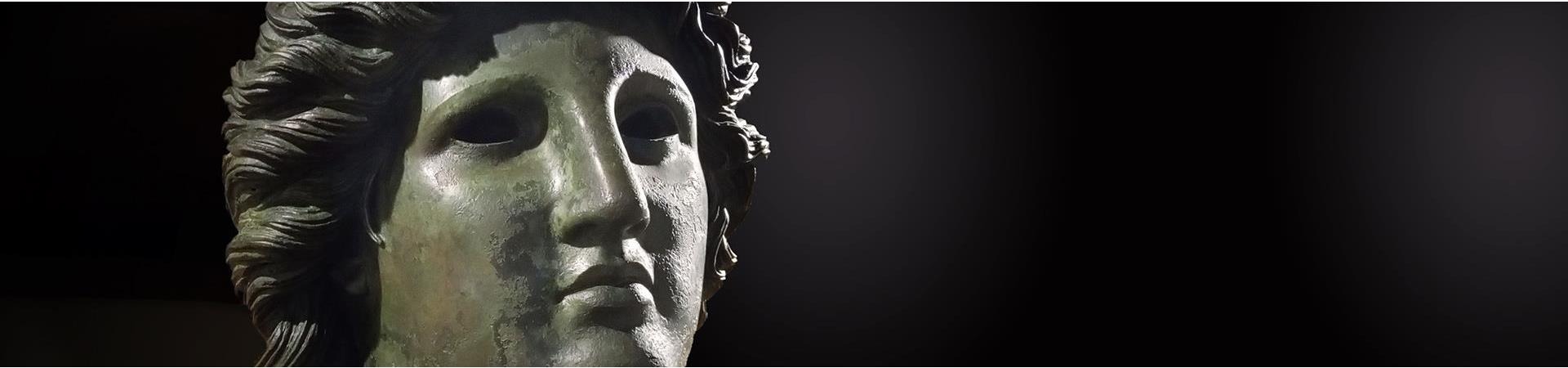
Daily objects and war trousseaus, tributes to the gods and splendid decorated vases are encountered along the exhibition route, up to the beautiful head of Apollo, which has become the symbol of the Salerno Provincial Museums.
The exhibition follows a chronological and topographical path.
- It starts from the lapidarium, in the small garden in front of the entrance, which collects works from the Roman Age such as statues, inscriptions and cinerary urns, found in the city of Salerno from the late 17th century onward.
- Theprehistoric section on the ground floor shows artifacts that can be traced mainly to the Neolithic and Paleolithic periods. Some of these objects were found in Palinuro and in the Polla cave and the Pertosa cave.
- The Iron Age is evidenced by finds on the main cultural currents that characterized Campania and Salernitano:
- the Villanovan culture, which involves the cremation of the dead, whose burnt bones are enclosed in a vessel covered by a bowl, if the deceased is a woman, or by a helmet, if a man. Materials from Pontecagnano and Sala Consilina are exhibited from this historical phase;
- the culture of pit tombs, dug directly into the ground, the existence of which is evidenced by grave goods from the Sarno Valley and Alto Sele.
- The Greek period is evidenced by pottery and bronze vessels dating mainly to the 6th century, while a 5th-century tomb including a skeleton and grave goods comes from Oliveto Citra.
- On the second floor are exhibits from the Etruscan-Campanian site of Fratte (6th – 3rd cent. BCE), an important settlement predating the Roman Salernum located on the northern outskirts of the present city.
- A specific section is devoted to the famous bronze head of Apollo (1st century BC – 1st century AD), unearthed in 1930.
The Pertosa cave is also a museum.
.
.
The exhibition is also on display on the first floor.
Vases depicting Greek mythological scenes, bronze vessels of Etruscan tradition, and grave goods.
Treasures to be discovered
- The Complex of St. Benedict
.
It was built between the seventh and ninth centuries, at the plateau known as Hortus magnus, on the eastern walls of the defense system ordered by Arechi II. In 930 the monastery assumed the rank of abbey. Important historical figures were housed within its walls, such as Abbot Desiderius, future Pope Victor III, and Gregory VII, who died here. The monastery, which over the years passed from the Benedictines to the Olivetans as a result of Napoleonic laws, was suppressed in 1807 and turned into a military district, while the church was used as the Royal Theater only to be returned to the Curia a century later. At present, several parts of the Romanesque quadriporticus and the Renaissance loggia of the “Castelnuovo Reale,” belonging to the palace of Queen Margaret of Durazzo, have been preserved.
- Head of Apollo – 1st century BC – 1st century AD.
The bronze head depicting the god Apollo was found in the waters of the Gulf of Salerno on December 2, 1930, after becoming entangled in the nets of some fishermen. The head represents an extraordinary example of Greek or Magna Greek-inspired bronzes of late Hellenism, believed by some to be the work of the Campanian bronzesmith Pasiteles, summus et artifex diligentissimus, active in Rome and Naples in the 1st century B.C.
- Deinos black-figure Atticus – late 6th and early 5th centuries BC.
Among the figured vessels from the Fratte necropolis, a large Attic deinos with black figures attributed to the Painter of Antimenes stands out. The deinos, like the crater, formed the central element of the symposium and was intended to hold wine. Of particular interest is the decoration of the vase, with richly illustrated mythological scenes. The work bears traces of a restoration that took place before its deposition in the tomb, testifying to the exceptional nature of the object already felt by the ancients.
Curiosities / to know
- Villanovian Culture
.
The “Villanovan culture” or Villanovan civilization dates back to the early Iron Age and represents the earliest phase of Etruscan civilization. The name derives from the locality of Villanova, a hamlet in the municipality of Castenaso near Bologna where, between 1853 and 1855, the remains of a necropolis, consisting of as many as 193 tombs,
were found.
- A miraculous peach
.
In the short story The Miraculous Fishing of May 5, 1932, Giuseppe Ungaretti recounts the miraculous finding of Apollo’s head and the poet’s visit to the museum itself: “It is already almost night, and in a line the anchovy fishermen return to port. Gathering the nets, one evening, at a mallet remained taken not the throat of a little fish, but at a cernecchio, a head of Apollo. It was then raised in the palm of a wrinkled hand, and, returned to give life to the light bleeding from the flames of the sunset – at the point of the neck where he cut it off – to that fisherman it seemed the Baptist. I have seen it in the Salerno Museum, and it may be Praxitelic or Hellenistic, it matters little: but this face, which for more than two thousand years was worked by the sea in its depths, has in its patina all the colors we have seen today, has shells in its ears and nostrils: has in its indulgent, quivering smile, I know not what song of resurrected youth! Oh! Thou art the serene strength and beauty. What good wish does not this image bring us, who, among the olive trees, has at last returned among us.”
- Ezio De Felice
The architect De Felice, who oversaw the restoration and layout of the Provincial Archaeological Museum between 1956 and 1964, is considered one of the leaders of the Italian museographic experience. An architect and university lecturer, an expert in restoration and museography, a multifaceted artist and collector, he signed numerous projects throughout Italy. The exceptional quality of his Salerno intervention brought him the National In/Architecture Award in 1966.
Loading…
| Day | Morning | Afternoon |
|---|---|---|
| Monday | not accessible | not accessible |
| Tuesday | 09:00 – – | – – 19:30 |
| Wednesday | 09:00 – – | – – 19:30 |
| Thursday | 09:00 – – | – – 19:30 |
| Friday | 09:00 – – | – – 19:30 |
| Saturday | 09:00 – – | – – 19:30 |
| Sunday | 09:00 – – | – – 19:30 |
Free Admission
Salerno by Bike between Sea and Mountains Artistic Historic Salerno angioina-aragonese Artistic Historic
 Ancient Salerno: between Etruscan and Romans Artistic Historic