


State Archives
- Description
- Event
- News
- Gallery
- Contacts
- Map
- Opening hours
- Itineraries
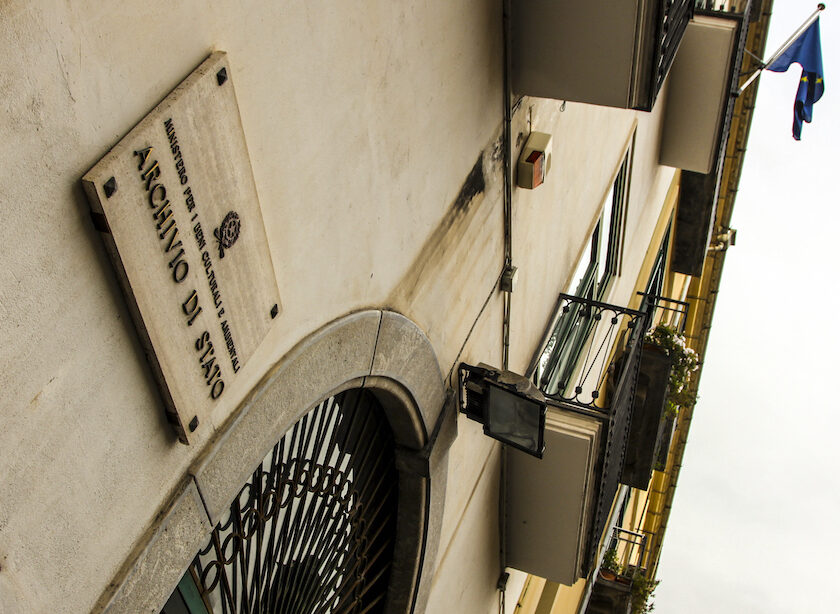
In one of the richest places in Salerno’s history, in what was probably the Hole of the Roman city, stands the palace that houses the State Archives, the site in Lombard times of houses and churches that have now disappeared. A palace was built here in Aragonese times, incorporating the Church of San Ludovico, recently made available to the citizenry with its beautiful frescoes.
For centuries this palace was the seat of the Regia Udienza, that is, the court of Salerno, and this destination was preserved for it with the advent in the early nineteenth century of the Napoleonic reigns and then by the Grand Criminal Court, which in Bourbon times defined the criminal court. It was only with the construction of the Palace of Justice at Corso Vittorio Emanuele in 1934 that the building’s purpose became its present one. The most famous trial was the one brought against the surviving protagonists of the Sapri expedition, with the death sentence, commuted to life imprisonment, of Giovanni Nicotera, the closest collaborator of Carlo Pisacane.
The Prison Court was the most famous criminal court in the Bourbon era.
The Heritage of the State Archives of Salerno is very rich: about hundred thousand pieces of paper records and more than thousand parchments, as well as a library of about twenty-four thousand volumes. Periodically, exhibitions and events are organized to showcase parts of the holdings, which inevitably also involve reperti of the Salerno Medical School, including some graduation diplomas.
Monday and Friday: 7:45 a.m.-1:45 p.m.
Tuesday, Wednesday, Thursday: 7:45 a.m.-5:15 p.m.
Cost: free
For CATASTAL SURVEYS four users per week will be admitted,
(two on Tuesdays and two on Thursdays) upon reservation at’email address: as-sa.salastudio@cultura.gov.it
via special form (downloadable here).
STUDY ROOM access reservation form (downloadable here)
Nessun itinerario disponibile.