


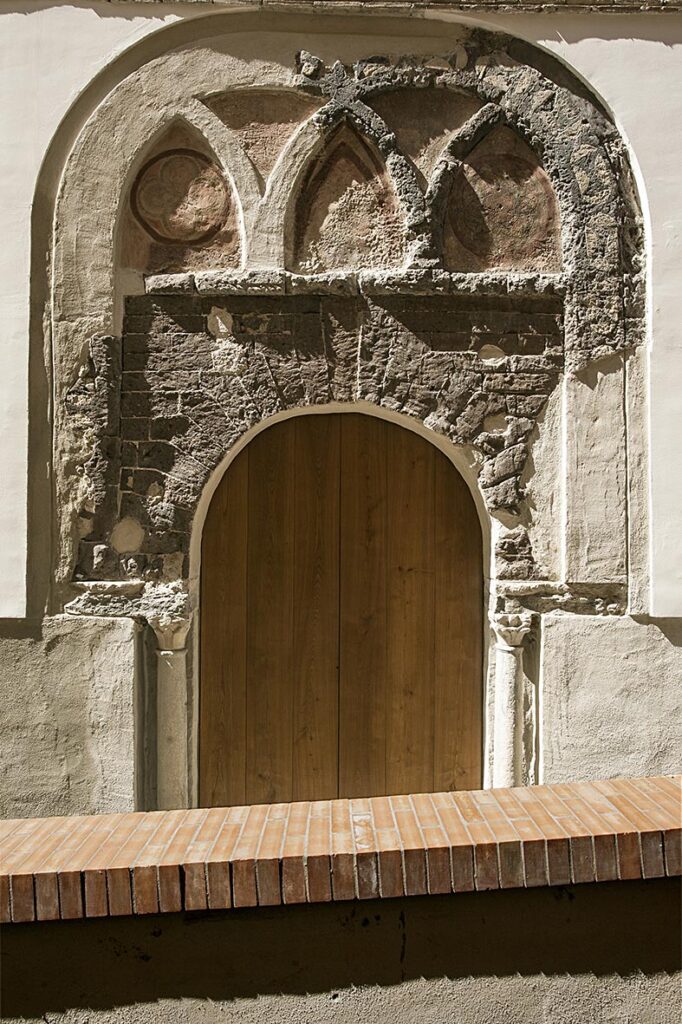
 Fruscione Palace Palaces and Squares Palazzo Fruscione, Vicolo Adelberga, Salerno, SA, Italia
Infiniti Mondi. Journey into the Poetics of Fabrizio De André.
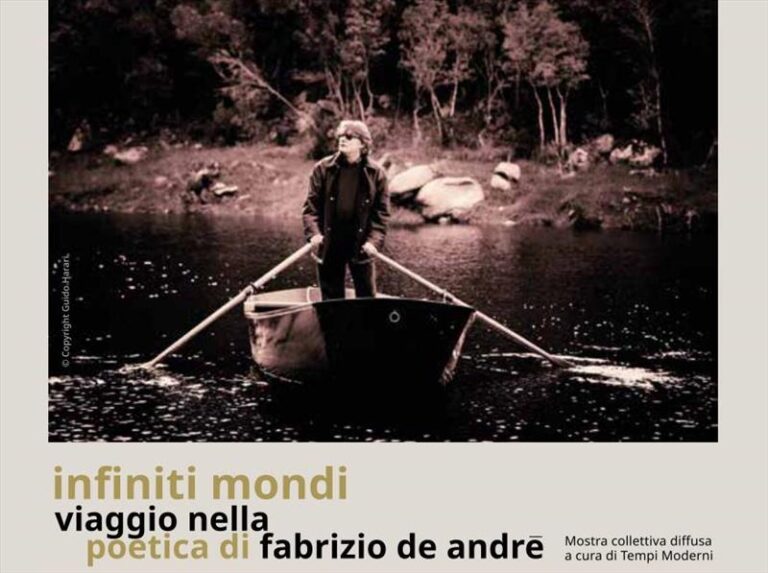
Eighteen international photographers, one sculptor and five illustrators will dialogue with the themes of the Genoese singer-songwriter's poetics.
- Event
- Place
- Date/Hours
- Tickets
- Map
- Related Events
- Editions
Tutti
Tempi Moderni
MODERN TIMES PRESENTS.
Infiniti Mondi. Journey into the Poetics of Fabrizio De André.
Eighteen international photographers, one sculptor and five illustrators
will dialogue with the themes of the poetics of the Genoese singer-songwriter.
Salerno Palazzo Fruscione | Diffuse Exhibition
March 21 to June 2, 2026
In the heart of the city’s historic center, the works
in dialogue with some historical-artistic sites and contemporary architecture
A visual journey into the fragile and powerful humanity sung by Fabrizio De André. It is entitled Infiniti Mondi. Journey into the Poetics of Fabrizio De André and it is the major exhibition, the only one of its kind, conceived and curated by the TEMPI MODERNI Association in its tenth year of activity. More than one hundred and sixty works in Salerno, from March 21 to June 2, 2026, will tell the poetic relevance of the themes that the Genoese singer-songwriter gave to the short century. To do so, Modern Times, has relied on the same lens with which, since 2016, it has been looking at the world: great storytellers in art photography, drawing and sculpture.
In the ancient heart of the city, the historic Palazzo Fruscione (where the main corpus of the exhibition will be on display), and in a path spread among evocative locations in the ancient center, the photographs of Gianni Berengo Gardin, Valerio Bispuri, Lisetta Carmi, Mimmo Dabbrescia, Barbara Di Maio, Mario Dondero, Luciano Ferrara, Guido Giannini, Gianluca Greguoli Venini, Guido Harari, Mimmo Jodice, Silvia Lelli, Cesare Monti, Lina Pallotta, Paolo Pellegrin, Ivan Romano, Reihnold Kohl; an auteur video by Gabriele Salvatores, illustrations by Stephen Alcorn, Paolo Castaldi, Pablo Echaurren, Matilde Grossi, Sergio Staino, and Maurizio Savini’s chewing gum sculpture will dialogue with the themes enshrined in Faber’s songs.
THE EXHIBITION ROUTE
The exhibition, is not an album of memories, but a listening device. Each shot is a threshold: it returns De André to his time and, in the same way, rewrites it in ours. A project, which also became a reality thanks to the kind and participatory confrontation of Dori Ghezzi and the De André Onlus Foundation, which she chairs. The itinerary opens with a journey through the iconographic work that, with a drop of splendor, photographers such as Mimmo Dabbrescia, Guido Harari, Gianluca Greguoli Venini, Cesare Monti, Reihnold Kohl, and Carlo Silvestri have dedicated over the years to Fabrizio De André; a drop of splendor that returns us to his passage through time, with the body aging, but not the thought, which becomes eternal.
In this path, the first of the “track songs,” will dress the colors of the works – some of them unpublished – of Pablo Echaurren, internationally renowned illustrator and writer, who will make us hold hands on the notes of a melancholic Girotondo. Alongside, a Gorilla of Chewing Gum will be Maurizio Savini’s homage to De André’s translation of Georges Brassens’ song in 1968. Intimate and familiar shots of Pier Paolo Pasolini with his mother Susanna, immortalized by Mario Dondero, will bring us back to the notes of Una storia sbagliata, a cry of grief recounting the death of the Friulian poet. With the portrait of Laura Santi, general councilor of the Luca Coscioni Association, taken by Guido Harari, the very delicate topic of the end of life is addressed to the notes of that Preghiera in gennaio, a secular supplication addressed to God, asking for mercy for a man (Luigi Tenco) who died by suicide.
The tale continues through Paolo Pellegrin’s unforgettable shots: the eyes lost in emptiness of little Maram after an Israeli bombing in Beit Hanoun, Palestine, and the frightened gaze of a Ukrainian soldier just enlisted in the army, in a dramatic dialogue between the conflicts sung by Faber in La guerra di Piero and Sidún.
It continues with the shots of the great Lisetta Carmi, whose lens told the story of the port city of Genoa in La città vecchia, immortalizing, even before De André sang it, the Morena of Via del Campo and, with the spirit of nonconformism and avant-garde that has always distinguished her, the transvestites whose sensitivity also animates, in the name of Prinçesa, the narrative spirit of another great protagonist of contemporary photography, Lina Pallotta; in a relationship of strong cultural identity, among alleys, sea and millenary history, the Genoese “feeling” meets the Neapolitan one, where the transvestite meets the Femminiello in Luciano Ferrara’s images, an identity portrait of an inclusive Naples that changes, but remains anchored to the classic of its eternal melodies, of which La nova gelosia is the legitimate daughter. And it is again Carmi’s photographic power, recounting the chiaroscuro of Hotel Supramonte’s Sardinia, that takes us into the cultural and social context in which the abduction of Dori Ghezzi and Fabrizio De André matured.
The exhibition continues with Canzone del maggio, inspired by the student uprisings in Paris in ’68, meeting the historical images of Gianni Berengo Gardin, one of the greatest masters of international auteur photography, in dialogue with Silvia Lelli’s precious and iconic images of the 1976 Festival of the Youth Proletariat at Parco Lambro in Milan. Also Berengo Gardin’s shots tell the nomadism of Khorakhanè with his work dedicated to the Gypsies of Florence, Trieste and Palermo; as well as his shots from “Morire di Classe” – one of the most important photography books of the Italian 20th century – interpretation of the verbal silence of the protagonist of Un matto, contributed, with the Basaglia law, to put an end to asylums.
A fitting tribute to Maestro Mimmo Jodice takes us to the seesaw of Ho visto Nina volare – a recollection of De André suspended between childhood and adulthood – where flight becomes a metaphor for the human desire to rise as a collective bridge between earthly time and transcendent time. His black and white blends with the intense color of Ivan Romano’s photos, which give a face to those migrants whose lives are too often lost in the abysses of the sea, to that desperate and lost humanity to which De André dedicates part of his last song, Smisurata preghiera. Barbara Di Maio’s photos, where serious, tired but strong faces can be glimpsed under black veils, are the image that evokes the female figures sung by Fabrizio De André in Via della croce.
And then again, the theme of prisons explored by Valerio Bispuri, whose shots, which contributed to the closure of Pavilion 5 of the Argentine prison of Mendoza and brought attention back to the inhumane conditions in which many Italian penitentiaries find themselves, are in dialogue with the young clerk sung by the Genoese singer-songwriter in the song Nella mia ora di libertà, an ordinary man who, on an ordinary day, thinks, in the emotional wake of the movements of Sixty-eight, that he can carve out his own space of salvation. Finally, the itinerary at Palazzo Fruscione closes with the video clip, by Oscar-winning director Gabriele Salvatores, La domenica delle salme, a work synthesizing the thoughts of the Genoese singer-songwriter.
THE WIDESPREAD EXHIBITION
The exhibition will be an opportunity to outline an emotional journey in DeAndrei’s themes also through the diffuse exhibition section, a walk through the city’s historical and architectural heritage. The path opens in the Foyer of the Verdi Theater with another photograph by Guido Harari that depicts De André in tailcoat, during a live performance of Ottocento, with open arms as if to welcome among them the entire city of Salerno. Again, in the renewed space of the Giardino della Minerva, on La collina, a tribute to Spoon River through a portrait, again signed by Harari, of Fernanda Pivano, who translated into Italy that masterpiece of 20th-century literature of which De André in the guise of the Suonatore Jones, realized a transposition into music with his Non al denaro, non all’amore né al cielo. In the empty-full dynamics of the Scalone of Palazzo Ruggi d’Aragona, and in the suspended atmosphere of the Cloister of the Convent of San Nicola della Palma, will inhabit Stephen Alcorn’s woodcuts, which, in the form of Tarot cards, will tell the passages of De André’s life to the rhythm of Volta la carta. In the Salone delle Esposizioni and the San Ludovico Chapel of the State Archives, the protagonists of Anime salve will come to life in the interpretation of illustrator Matilde Grossi. Again, in the Hypogeum in San Pietro a Corte and the enclosed Chapel of Sant’Anna, will find space for the illustrated adaptation of Ave Maria and Three Mothers, by Paolo Castaldi, where a deposition of Christ in the arms of Mary with the rubble of a modern-day war behind him, dialogues with an evocative shot of Mount Sant’Elia in Calabria, by Guido Giannini, where three crosses soar over the mist of a silent valley. The tale continues in the Cittadella Giudiziaria gardens with Valerio Bispuri and his Anime salve, orphans in Pakistan. Finally, in the Chiostro della Pace – designed by Ettore Sotsass jr – in an ideal bridge with the University of Salerno, we will find the pencil of Sergio Staino to tell us about two great classics: Il pescatore and Bocca di rosa.
THE REVIEW.
Along with the exhibition, The Tales of the Contemporary returns, now in its 10th edition. A review that this year will be titled “We sail on fragile vessels,” updating a verse from that Recitative that closes De André’s 1968 album, Tutti morirono a stento. A passage that represents the sense of unease and disorientation we experience these days. A festival that once again is a choral journey that proceeds between creativity and visions, but also an important space for reflection on the cultural process and its importance in the history of humanity’s history.
A tenth edition that still combines sounds, visions, words and encounters to question the deeper meaning of the themes proposed in the exhibition and what the world around us today really is. To do so Tales of the Contemporary will also resort to the words of a Nobel laureate in physics, Professor Michel Devoret, who won the prestigious award in 2025 for his discovery of the macroscopic quantum tunnel effect and the quantization of energy in an electric circuit. The French physicist will dialogue with Yale University Sterling Professor of Humanities and Film and Media Studies Francesco Casetti, and together they will connect the invisible dots that link physics and cinema: two parallel universes.
From the photographs on display to their authors. Our Tales of the Contemporary will also be an opportunity to get up close and personal with some of the prestigious names who sign the images and works of Infiniti Mondi. From Valerio Bispuri to Guido Harari via Lina Pallotta and Susanna Berengo Gardin, but also, for his story, Franco Turcati, up to the artist Pablo Echaurren guest with director Antonello Matarazzo on the occasion of the screening of the documentary “Pablo of Neanderthal”
A review that also wants to be an opportunity to celebrate ten years of activity with the participation of those who, in this decade, have crossed and enriched our telling. Starting with singer-songwriters, Elisa Ridolfi, Francesco Di Bella, Manù Squillante but also new friends such as Gnut and Alessandro d’Alessandro, Max Manfredi, Cristina Pucci, Claudio Covato and Giulia Mei: the latter together with director Andrea Walts will tell about the beautiful transcription in Sicilian of La buona novella. For the “sounds” section we will meet again accordionist Salvatore Cauteruccio with his quartet; saxophonist Carla Marciano; and double bassists Pierpaolo Martino and Aldo Vigorito. From the stage of Palazzo Fruscione to that of the Athenaeum Theater. In Fisciano, the concert Creuza de mä 42 years, a Mediterranean, an original production of the Brescia De André Festival, with live painting by Paolo Castaldi. Also, Canti e tanghi per Staino: the musical world of Bobo a tribute to the never forgotten Sergio Staino. Here, the pencil of Bobo’s dad sings along with Alessio Lega, who, accompanied by Guido Baldoni’s accordion and Michele Staino’s double bass, interprets De André, Guccini, Conte, and great Italian songwriters.
The “pages” will be given over to talk hosts Maria Procino, who will tell us about the correspondence between Eduardo and Luca De Filippo; journalist and music critic Gino Castaldo; and writer Luca Trapanese, with his beautiful family history. And, again, journalist and writer Alfredo Franchini; Serbian writer Djana Pavlovic; psychiatrist Gabriele Catania and “De André therapy” experienced through his patients. And, again, photographer and writer Giuseppe Mastromatteo with writer Corrado de Rosa, while with Alessandra Mauro, editorial director of Contrasto, we will stretch our gaze over 15 memorable photographs. We will tell about the centenary of Dario Fo and the 50th anniversary of Alfonso Gatto’s passing. So many university professors will help us to decline the themes of the exhibition, Annamaria Sapienza, Carmine Pinto, Giso Amendola, Federico Boni, Simone Giorgino, Ettore Giap Parini, Stefano di Tore, Massimo Cerulo, Giovanni Boccia Artieri, just to name a few and the two actors, Pierluigi Gigante and Claudio di Palma.
This year, then, a new section is inaugurated: Passion Photography. The story of those who, while not being professionals in photography, intended to try their hand at this art moved precisely by passion. We will discover the gaze of Corradino Pellecchia, Lello Campanelli, Adriana Adinolfi, Carlo De Luca, Michele Mari, Ugo Villani and Paola Bruno. Completing the review, the usual Sunday appointment with cinema, with titles that expand Fabrizio de André’s poetics to the seventh art, with auteur presentations with, among others, Corrado de Rosa, Piera Carlomagno, Eduardo Scotti.
Finally, an important in-depth meeting on Welfare and Cultural Work with Giovanni Boccia Artieri (president Santarcangelo dei Teatri), Virgilio D’Antonio, (magnifico rector University of Salerno), Elisa Fulco (art historian), Andrea Lombardinilo (president of La Quadriennale di Roma), Roberta Paltrinieri (professor Alma Mater Studiorum, University of Bologna) Andrea Prete (president of Unioncamere and Chamber of Commerce of Salerno) Antonio Sada (president Confindustria Salerno).
The exhibition Infiniti Mondi (Infinite Worlds), is organized and curated by the Modern Times Association in collaboration with the City of Salerno, the Superintendence of Archaeology, Fine Arts and Landscape of Salerno and Avellino, the Salerno State Archives, the Ebris Foundation, the Salerno Medical School Foundation, the “Giuseppe Verdi” Theater of Salerno, the Salerno Court of Appeal and the Salerno Attorney General’s Office, and the University of Salerno. It is promoted and supported by the Campania Region, the City of Salerno with the “Giuseppe Verdi” Theater and the Salerno Chamber of Commerce I.A.A. The review Navighiamo su fragili vascelli is conceived and organized by the Modern Times Association, promoted and supported by the Campania Region, City of Salerno with the “Giuseppe Verdi” Theater and the Chamber of Commerce I.A.A. of Salerno. Under the patronage of Campania Region, Province of Salerno, City of Salerno, Salerno Chamber of Commerce I.A.A., Confindustria Salerno, University of Salerno, Carisal Foundation, Ordine dei Giornalisti della Campania and, for the Sounds section of the Review, Assomusica.
With contributions from: Allianz of Parrilli and Sanfilippo, Banca Campania Centro, Centrale del Latte Spa, Con-tra Spa, De Luca srl, Carisal Foundation, Ebris Foundation, Saccone Foundation, Tosi Foundation, Metoda Finance srl, Project Finance 4.0, Ritonnaro Spa, Sada Spa. Technical sponsors: Boccia Industria Grafica spa, De Cesare Viaggi, Del Basso parquet, Guardian Srl, Marsia, Studio Pedone and Tomeo Architet’s Lab, Santoro Grafica srl. In collaboration with: Agesci Scout Group Salerno 10, Lab 147 Cultural Association, Cerzosimo studio and visual, De André Festival of Brescia, Festival libro aperto, Saccone Foundation, Foto Diego, Feltrinelli Librerie, Ordine dei Giornalisti della Campania, Sony Music, Teatro “Giuseppe Verdi” Salerno, University of Salerno. Media partners: Campania Life, RCS, RCS Zone, Salerno News24.
The cultural association Tempi Moderni, chaired by lawyer Marco Russo, was founded with the aim of networking through culture and creating synergies that can make Salerno the starting point and reference point for the construction of a laboratory of energies and projects capable of acting as a driving force for the social, and, above all, tourist and economic development of our urban fabric. Modern Times debuts with the exhibition of Dino Pedriali’s historic photographs of Pier Paolo Pasolini in 2016, then the exhibition of paper cutter Marco Gallotta in 2017, that of internationally renowned chewing gum sculptor Maurizio Savini in December 2018–January 2019, again, the exhibition Stardust: Bowie by Sukita, featuring the stunning images of renowned Japanese photographer Masayoshi Sukita, held in 2020, Stories From The Rooms, from 2021, with a group show of 23 photographers, video art and contemporary art, dedicated to the iconography of New York’s Chelsea Hotel, and again, Nouvelle Vague, with photographs by Raymond Cauchetier, Douglas Kirkland and the Archivio Luce Cinecittà, enhanced by illustrations by Victoria Semykina, and Antonioni and Vitti, a History of Love and Cinema, with photographs by Enrico Appetito, from 2022; again, the Exhibition Glances (Nucleus/ Kontakthof Kontrapunkt /Music/ Shadow and Penumbra) by Silvia Lelli and Roberto Masotti, from 2023; in 2024, Letizia Battaglia’s first diffuse exhibition, A Life Like a Punch, Like a Caress; the Diffuse Exhibition Flashes of Genius. Photographs by Philippe Halsman, again The Paths of the Sacred, a group show with 9 extraordinary artists, exhibitions that – accompanied by a series of talks, literary meetings, film screenings, concerts, in a Review that goes by the name of “Tales of the Contemporary” – have, over the past 10 years, met with great approval from the public with thousands of visitors each year.
Fruscione Palace Palaces and Squares Palazzo Fruscione, Vicolo Adelberga, Salerno, SA, ItaliaGratuito
Tutti
Intero: € 10,00
Ridotto: € 8,00 under 25 (13-25 anni), persone con disabilità, gruppi (min 20 persone)
- € 12,00 intero
- € 10,00 ridotto under 25 (14-24 anni), persone con disabilità, gruppi (min 20 persone), convenzioni con La Feltrinelli, FIAF, Ecstra
- € 6,00 ridotto speciale scuole
- Ingresso Gratuito: minori di 14 anni, 2 insegnanti accompagnatori per classe, guide turistiche italiane munite di tesserino di abilitazione, giornalisti con tesserino ODG previo accredito presso l’Ufficio Stampa, 1 accompagnatore per persone con disabilità che presentino necessità e regolare documentazione
- € 13,00 open (possibilità di visitare la mostra in un giorno a propria scelta e nell’orario desiderato, saltando le eventuali code).
Orari Mostra
Ingresso Palazzo Fruscione
- Lunedi: 16.30-20.30
- Da martedì a venerdì: 9.30-13.30, 16.30-20.30
- Sabato e festivi* 10.00-21.00
- *5 aprile (Santa Pasqua) 10.30-13.30, 16.30-20.30
- *6 aprile (Lunedì in Albis), 25 aprile, 1° maggio, 2 giugno: orario continuato, 10.00-21.00
Chiusura: lunedì mattina, salvo aperture straordinarie su richiesta per scolaresche e gruppi.
Event News
There is no news for this event.