


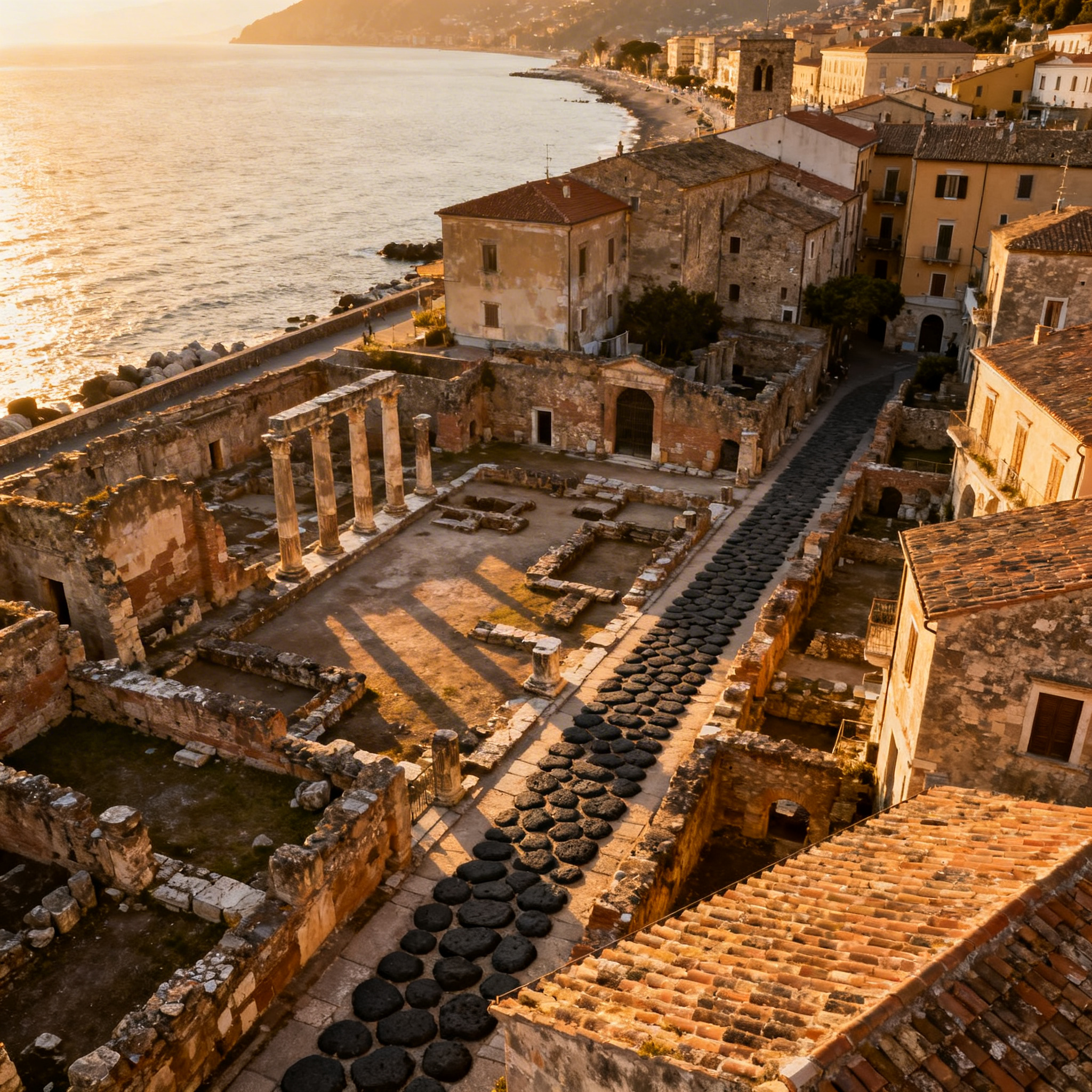
Salerno was founded as a Roman colony in 197 B.C. and had a prosperous life for centuries. The remains of the Roman city lie beneath the houses in the Old Town, and some valuable works are preserved in the Archaeological Museum.
The Salerno area has been inhabited since ancient times: an ideal place, with the river and the sea nearby since the Paleolithic period there are settlements discovered by archaeologists. In the 6th century B.C. the Etruscans founded a city, probably named Irna, the remains of which can be found in the district of Fratte, with a necropolis, the most valuable and important objects and remains are preserved in the Archaeological Museum.
But Salerno was founded by the Romans as a colony in 197 B.C., in a strategic area, protecting the Sele valley inhabited by the Picenes, deported here because of their alliance with Pyrrhus and then Hannibal. The city, protected by the mountains and the sea on three sides, presented a wide plain from which any enemies had to cover, past the Irno River, a large uncovered space to reach the walls, in a position that covered at least part of the present Historic Center. The city was crossed by the Via Ania – Popilia, which joined Capua to Regium, so it was also internal to the commercial traffic, which, combined with the sea port, probably made it rich.
The medieval city grew up on the remains of the ancient Roman city, so it is difficult today to reconstruct the places and spaces; digging into the foundations of the houses and public spaces of the Historic Center there are finds that testify to the vestiges of the ancient city. Between Palazzo Fruscione and the Palatine Chapel there are, clearly visible, the remains of baths, and other remains are at Vicolo della Neve.
Then there are the urbanistic traces, the Forum that probably encumbered the present Abate Conforti Square, and still the shape of the Roman square can be recognized. Piazza Flavio Gioia-the “Rotunda”-has been attributed to the site of the Theater, and although today the hypothesis is discarded by archaeologists, its round shape with a view of the sea makes for an evocative location. Then there is, preceded by a fine portico of reused columns, the Temple of Pomona, adjacent to the Bishop’s Palace.
Perhaps the most interesting works are the sarcophagi that are now in the atrium of the Cathedral, some valuable, and used again in the Middle Ages as tombs of contemporaries.
The bronze of Apollo preserved in the Archaeological Museum is the most artistically splendid example from the Roman city and is one of the symbols of the city of Salerno.
 L'evento inizierà tra 167 giorniSan Matteo fest Free admission 21 Sep 2026