


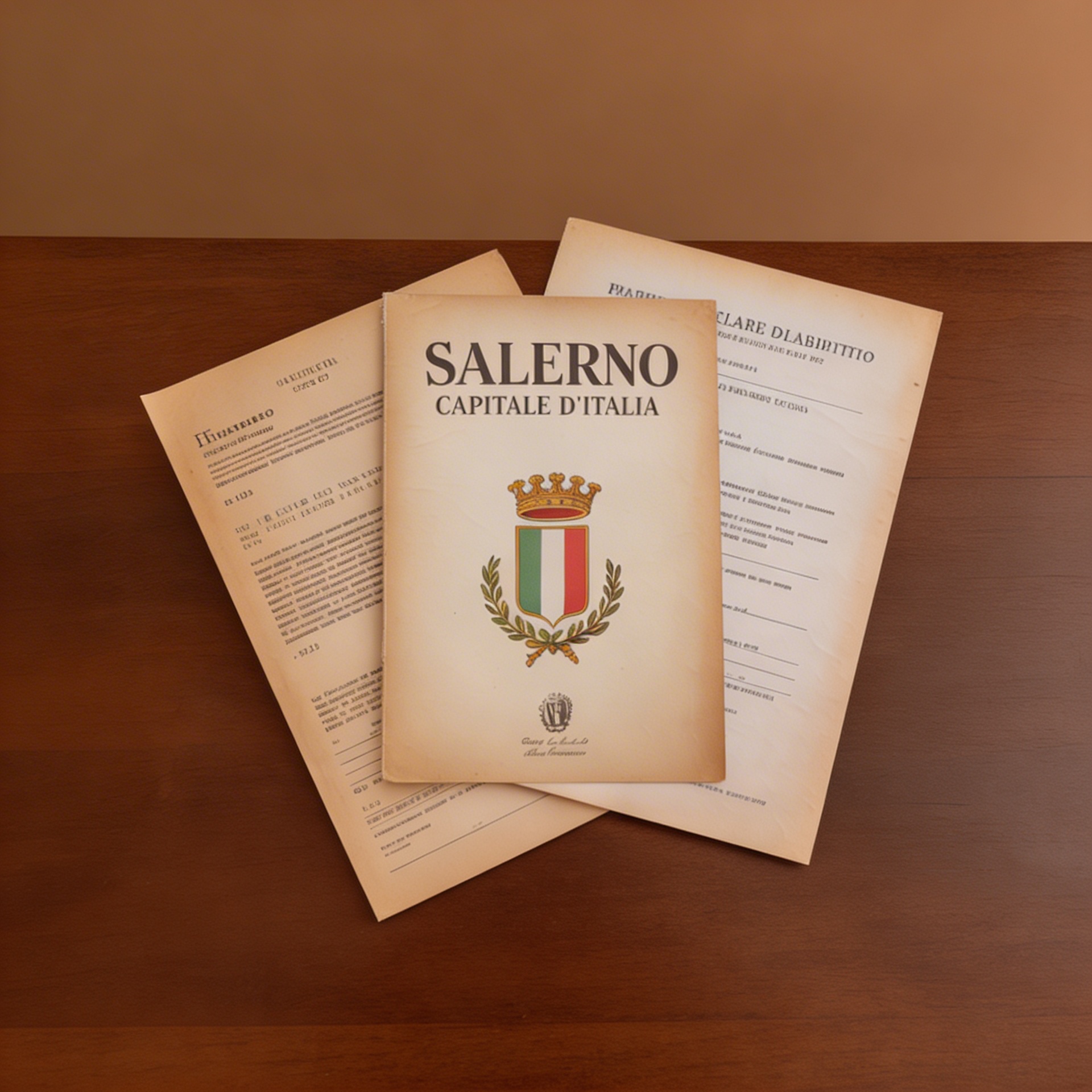
Salerno was the capital of the Kingdom of Italy for five months of 1944, hosting three different governments and King Victor Emmanuel III.
Salerno was the seat of government and Royal Residence from February 11 to July 15, 1944. In September the year before, one of the most important Allied landing operations of the entire war had taken place in Salerno and its gulf, the one that, precisely, took the name of the Salerno Landing. It was September 9, the day after the proclamation of the armistice between Italy and the Allies, a date that was supposed to mark the end of the war and was instead the prelude to the most dramatic period of war and devastation for our country. Operation Avalanche, as it was code-named, saw the landing of American and British troops under the command of U.S. General Mark Clark all over the Gulf, from the small beaches of the Amalfi Coast, which were to create beachheads to Nocera, to the large beaches to the left and right of the Sele River, which would make up the bulk of the landing. It was a long and bloody battle, with the German troops defending themselves with order and determination and were several times on the verge of throwing the landed men back overboard. But at the end of ten days of hard fighting, the German troops retreated north of the Volturno River, making the conquest of Naples, the true and great goal of the landing, possible.
Thus it was that Salerno, partly because the front then stopped at Cassino for a year, became the main center of government for liberated Italy, and it was decided to move the King here and to house the Badoglio government, which was the first after the military occupation to take administrative control of liberated Italy, control that had until then been with the occupying military. The King went to live in Raito, in that villa Guariglia which is now a ceramics museum, while the ministries were divided between the Palazzo di Città, where the Presidency of the Council was precisely located, and other palaces, from the Tribunal, where the Ministry of Justice was based, or the Palazzo delle Poste for the counterpart ministry, or Palazzo Natella, for the Ministry of Public Works.
Three different ministries followed one another in Salerno, two headed by Badoglio and one by liberal politician Ivanoe Bonomi. It was between the second Badoglio government and the Bonomi government that there was what was called the “Salerno Turning Point.” The secretary of the Italian Communist Party, Palmiro Togliatti, arrived in Salerno from the Soviet Union where he had resided during the Ventennio, and announced that pending the liberation of the entire Peninsula, there was a need for the unity of all anti-fascist parties and to set aside the institutional question until after liberation. Until then the parties had refused to collaborate with the monarchy, which was colluding with the Regime, but Togliatti made unity against fascism privileged over all other demands. With the liberation of Rome in June 1944, the capital became the Eternal City once again.
During the period of “Salerno Capitale,” Salerno’s minister of education, Giovanni Cuomo, established the Magistero, bringing university studies back to the City.
 L'evento inizierà tra 167 giorniSan Matteo fest Free admission 21 Sep 2026