


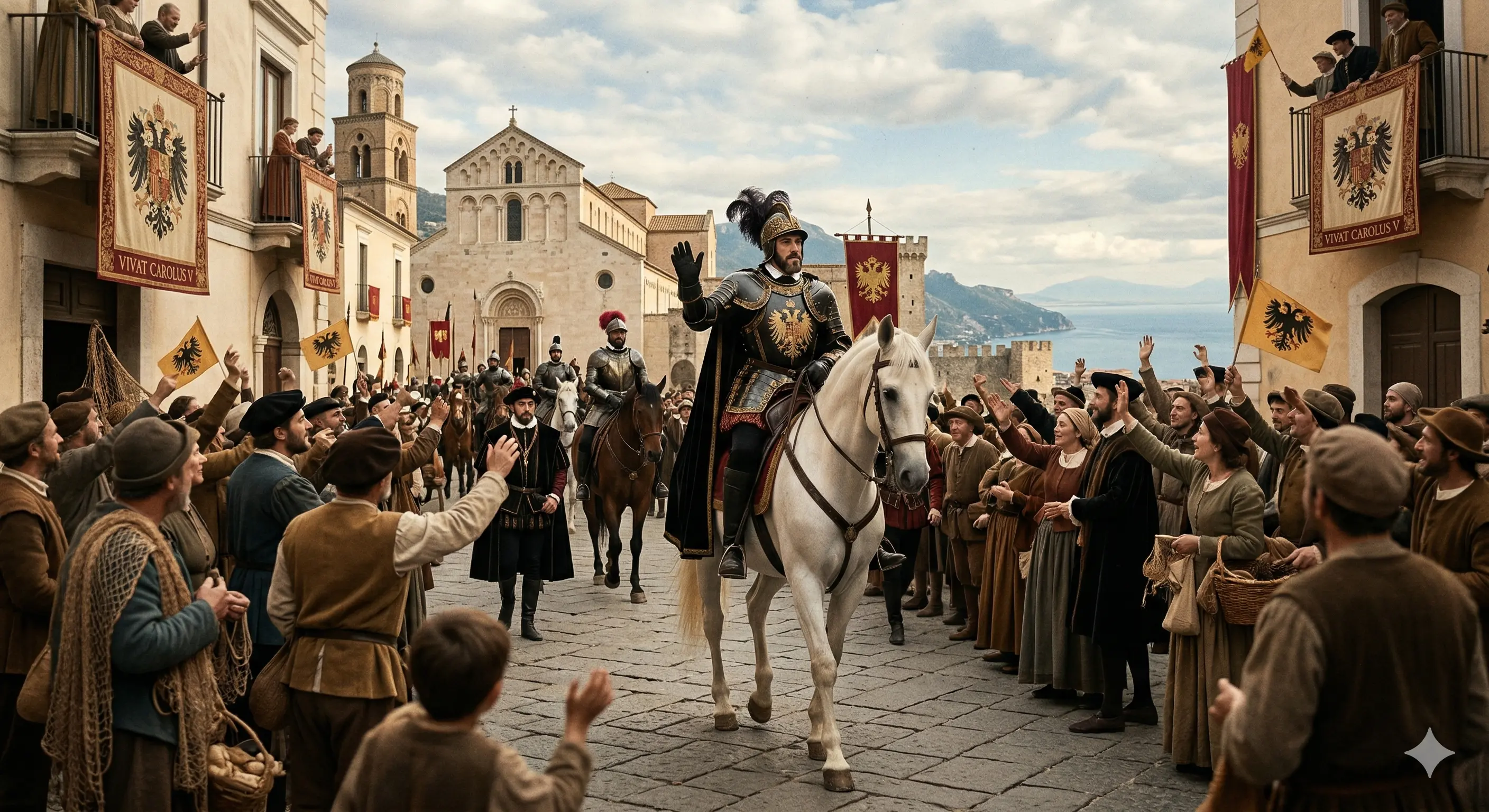
Charles V on his trip to Southern Italy, passed through Salerno and was the guest of Prince Ferrante di Sanseverino, who nurtured a dream of a cultural capital for the city.
Charles V, the Habsburg emperor over whose reign the sun never set, arrived in Salerno on November 18, 1535. The emperor had made a victorious military expedition to Tunis, and as a conqueror and warrior, he decided to cross the southern part of his kingdom to get to Rome and then on to northern Europe. The journey lasted more than two months, touched Sicily the longest, and then crossed into Calabria and entered the possessions of the Prince of Salerno, Ferrante di Sanseverino.
Between history and legend-at the Carthusian Monastery of Padula there is talk of a mythical omelet of a thousand eggs for the emperor who had stopped there to devote himself to a hunting trip-some historians tell of a stop in Salerno, a guest of the Ruggi d’Aragona Palace. Certainly the prince of Salerno had organized the Campania stop with great care. Residing between Naples (where he lived in the palace that later became the Gesù Nuovo Church) and Salerno, he had the idea of an autonomous Kingdom of Sicily, and in Salerno he had hosted a series of men of letters and intellectuals who had made it the cultural capital of his possessions.
From Agostino Nifo to Bernardo Tasso (the father of Torquato, who some speculate was born here) to Girolamo Seripando, one of the protagonists of the Council of Trent, there were many high-level intellectuals at Ferrante’s Salerno court. And this was the epriode in which Andrea Sabatini, a pupil of Raphael, painted his most beautiful and famous works, now preserved in San Giorgio and in the picture gallery of the Diocesan Museum. Charles V’s visit was meant to celebrate the power of the Prince, and give his ideas of autonomy legitimacy.
On the occasion of the visit, Charles V met Ferrante’s beautiful and very noble wife, Isabella di Villamarina, with whom he would stay in touch for years with a cultural exchange of letters-now preserved in Spain. And the relationship between the Emperor and the Princess continued even after her husband fled to France, a flight due to the failure to realize his dreams of autonomy from the Spanish Crown. With Ferrante’s demise also ended the project of a cultural capital in Salerno, which experienced the darkest phase of its history, a phase that led it to a decline from which it would never recover.
 L'evento inizierà tra 167 giorniSan Matteo fest Free admission 21 Sep 2026