The museum
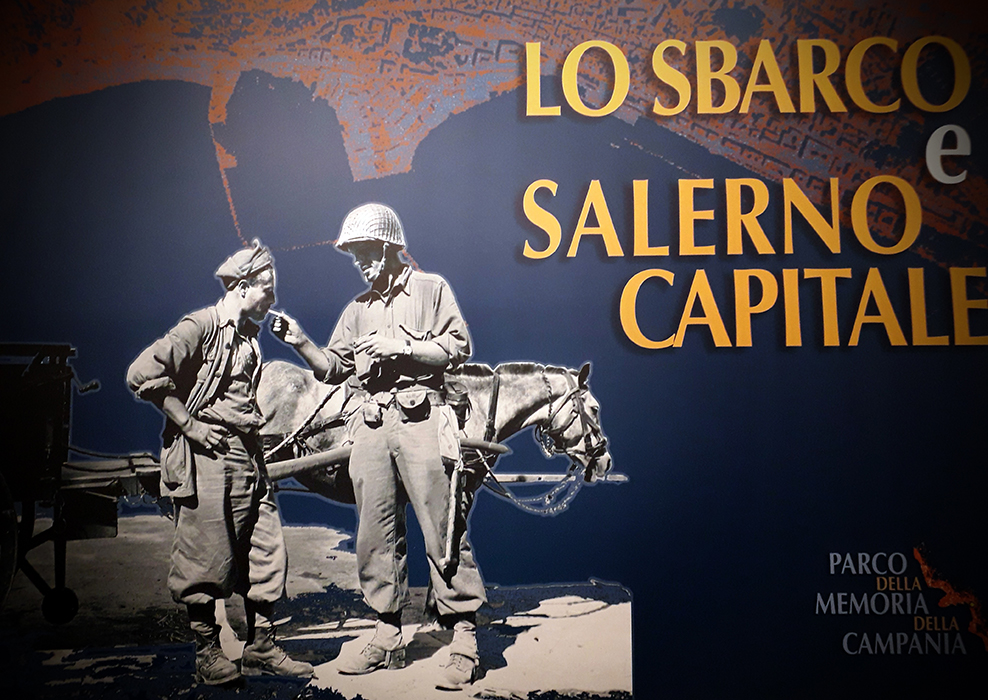
The Landing Museum, inaugurated in September 2012 under the high patronage of the President of the Republic, is dedicated to one of the crucial periods of World War II, which began on September 9, 1943 with Operation Avalanche led by General Clark, after whom the waterfront in front of the museum’s headquarters is named.
It was precisely the Salerno coast that witnessed the arrival of 200,000 soldiers in the most important amphibious operation in modern history, prior to the Normandy landings: a key moment for the world conflict and for the future destinies of Italy.
In the period following the landing, Salerno hosted the first governments of post-fascist Italy and the royal family, becoming de facto ‘Capital’ until the liberation of Rome (June 5, 1944). This period saw the so-called “Salerno Turning Point” in which the anti-fascists, the monarchy and Badoglio found a compromise for a government of national unity.
The exposition
The exhibition includes about 200 artifacts from the collection of the ’association “Campania Memory Park”.
Among the exhibits are unpublished footage of the landing, photographs, medals, military uniforms of the German and American armies, weapons and equipment. Outside the museum is preserved an M4 Sherman tank, a Willis jeep and a plumbed rail car used by the Nazis to deport Italian Jews. The latter is one of the few remaining examples in the world of those destined for the Auschwitz concentration camp.
Curiosities
The military badge (Patch) of the 36th U.S. Engineers stationed in Salerno in the aftermath of the landing, which inspired Salerno painter and cartoonist Gabriele D’Alma to paint the logo of the Salernitana soccer team.
In 1990, the Caribbean island of Grenada, part of the British Commonwealth, issued a stamp commemorating the Salerno Landing of September 9, 1943.
To Know
Code-named Operation Avalanche, the landings began at 3:50 a.m. on Sept. 9, 1943, a few hours after Pietro Badoglio had informed the Italian people, via radio, of the’armistice with the Anglo-American Allies. The landing force, led by U.S. General Mark Waye Clark, consisted of 450 amphibious units carrying 100,000 British soldiers and 70,000 Americans, all from North Africa and Sicily.
Salerno was the seat of government and Royal Residence from February 11 to July 15, 1944. During those months, King Victor Emmanuel III went to live at Villa Guariglia in Raito, while the ministries were divided between the City Palace, where the Presidency of the Council was precisely located, and other palaces, from the Tribunal, where the Ministry of Justice was based, or the Post Office Palace for the counterpart ministry, or Palazzo Natella, for the Ministry of Public Works. With the liberation of Rome in June 1944, the capital returned the Eternal City.
- The Salerno Turning Point
.
The secretary of the Italian Communist Party, Palmiro Togliatti, arrived in Salerno from the Soviet Union where he had resided during the Ventennio and announced that, pending the liberation of the entire Peninsula, the unity of all anti-fascist parties was needed and the institutional question should be set aside until after liberation. Until then the parties had refused to collaborate with the monarchy, which was colluding with the Regime, but Togliatti made unity against fascism privileged over all other demands.



 L'evento inizierà tra 167 giorniSan Matteo fest Free admission 21 Sep 2026