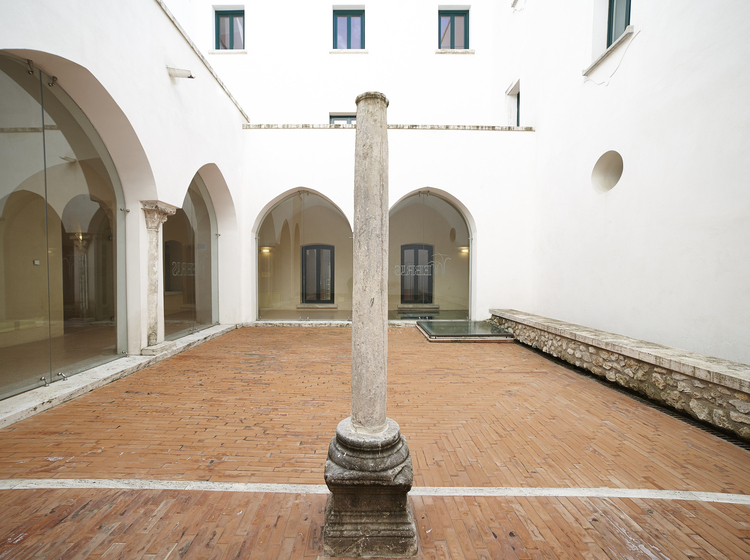
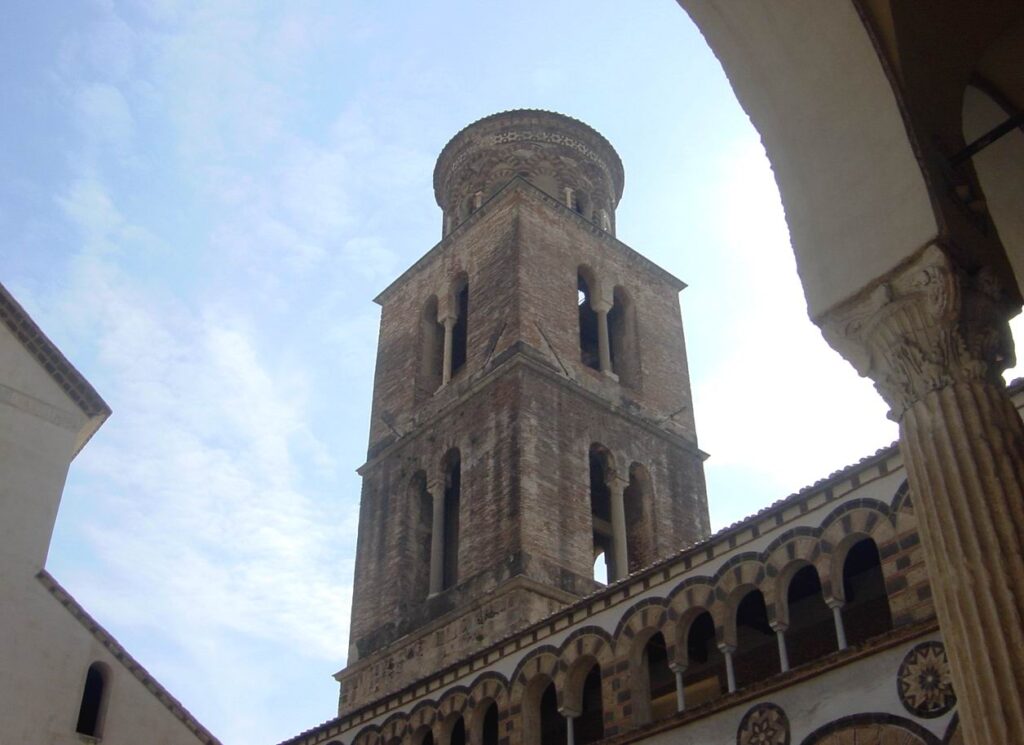
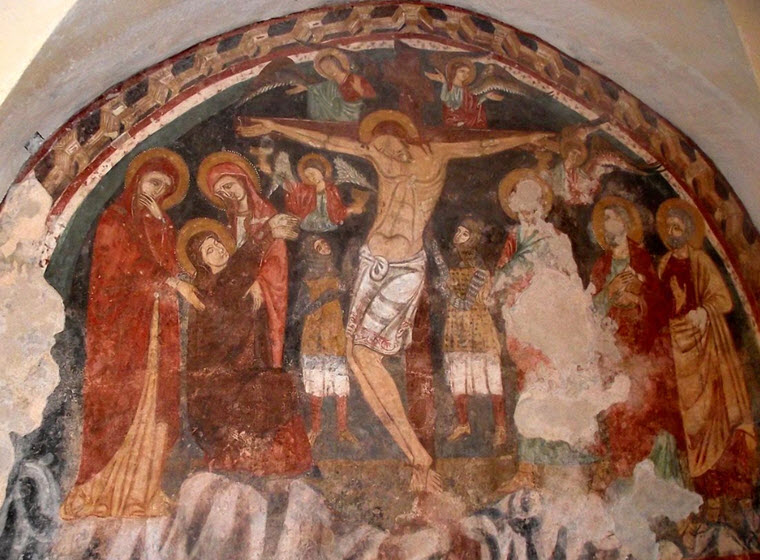
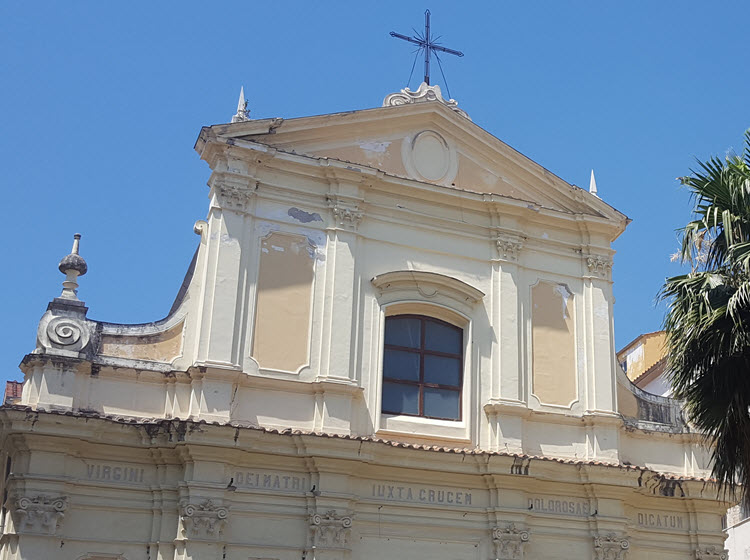
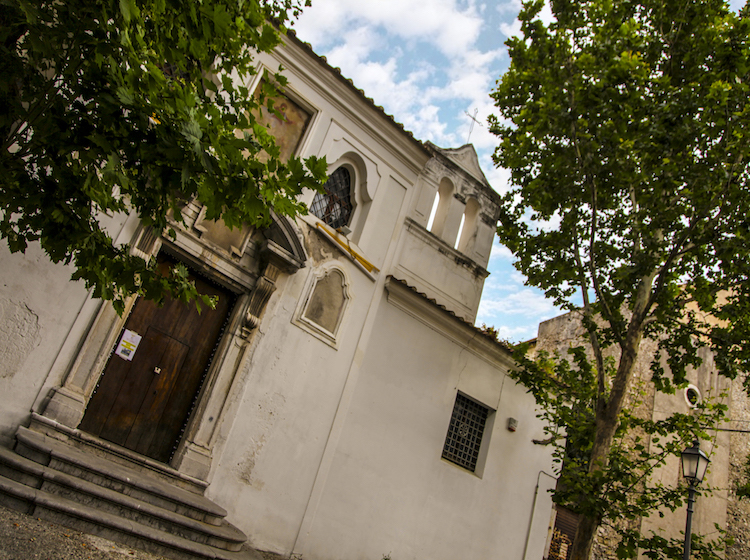
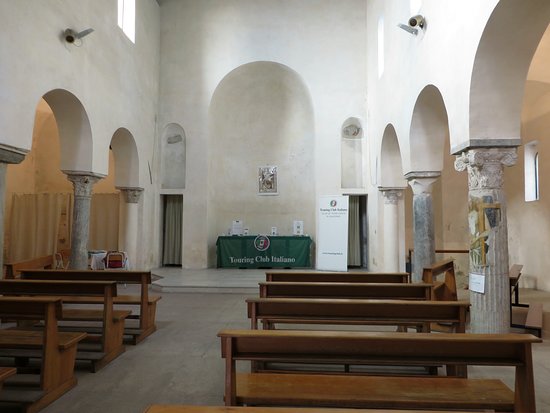
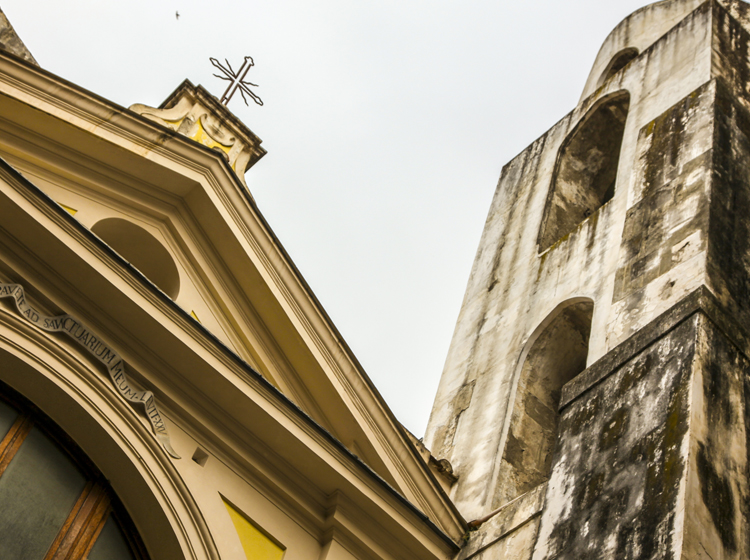
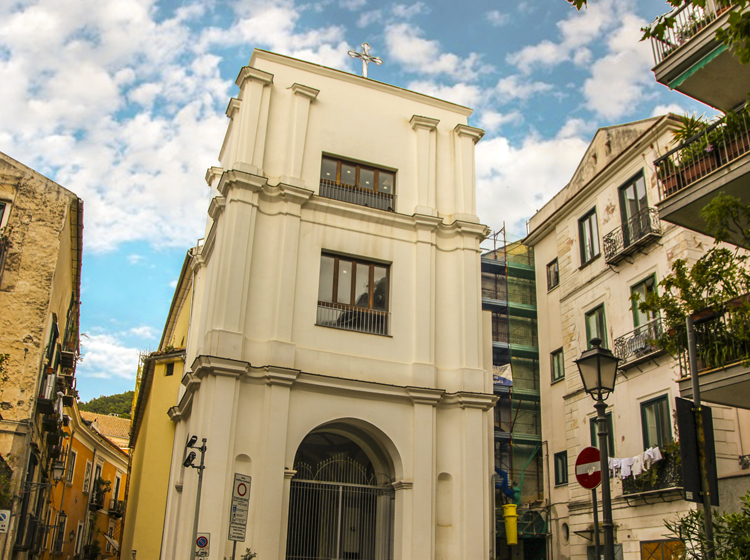
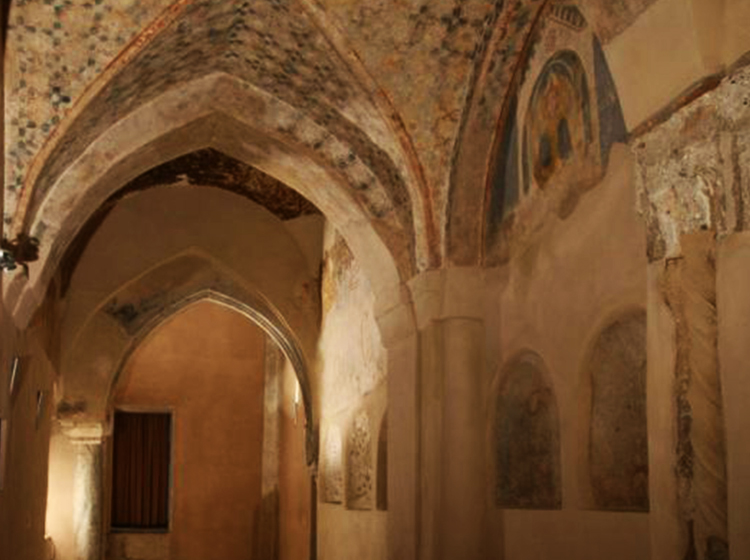
S. Nicholas of the Palm, which arose in the second half of the 12th century in the area of the city known in medieval documentation as Plaium montis, a wide terrace opening onto the steep slope of the hill on top of which the Lombard castle stands. The church, soon to be flanked by a monastic complex, was founded around 1061 by the joint will of two notable figures, Leo, second abbot of the Benedictine monastery of the Holy Trinity of Cava dei Tirreni, and the gastaldo Vivo, an officer in the service of the last Lombard prince of Salerno, Gisulph II. In St. Nicholas, therefore, the spiritual interests of the leader of one of the main abbeys in southern Italy and those of a member of the Lombard aristocracy were welded.
The site of the settlement was the site of a Roman abbey.
The site of settlement of the new monastic foundation was peculiar; in fact, it rose in the vicinity of one of the countless springs that dotted the Plaium montis and the Bonadies hill. Despite the fact that in the last century the water table was eroded by work on the construction of the S. Lucia railway tunnel, even today the entire area is characterized by the presence of natural springs and lush gardens fed by them. A prime example is the Giardino della Minerva, one of the oldest botanical gardens and rightfully among the most famous in the world. The spring near the coenoby, recorded in documents as aqua que dicitur de Palma, is attested as early as 1057. The water that flowed from here, through a pipeline that crossed the city longitudinally, supplied various city cenobia from the hillside to those near the maritime.
The presence of a balneum, i.e., a structure fed by running waters intended for washing the body, should be linked to the palm spring. Represented perfectly by the thermae of the Roman age, these types of complexes did not cease to exist altogether with the end of the ancient world but, now devoid of the complex articulation that had distinguished them previously and passed under the control of religious institutions, bishops first and monasteries later, they marked some territories even in the later period. It was the balnea that inherited the “thermal” functions in the Middle Ages, when the act of washing took on a particular and sometimes dichotomous religious and moral dimension. While washing could take on characteristics related to vice (evidently to be related to the nakedness of bodies), on the other hand the act also symbolically represented cleansing oneself of sin before approaching sacred places or liturgical celebrations. Above all, the use of the balneum was associated with curative approaches: it is no coincidence that in the Benedictine Rule itself, usually very circumspect about washing, interpreted as a sign of slackness if not outright impudence, the attendance of balnea was recommended for infirm monks. Consequently, the balneum of S. Nicola della Palma constitutes a monument of inestimable importance, not only as a peculiar element in the daily life within the monastery but also because it represents one of the few and oldest evidence of such facilities in the medieval South. Moreover, it is currently the only monastic balneum of which there are substantial material traces within the urban circuit of Salerno, of which, as mentioned above, the monastery itself constituted a religious nucleus of no secondary importance. In February 1071, in fact, the archbishop of Salerno Alfano I allowed the religious to exercise certain parochial rights, such as the blessing of the Easter candle and houses, sprinkling with holy water, visiting the sick, and receiving the dead in the abbey church and burying them. These are, therefore, extremely important religious functions that were usually the preserve of the prelate alone.
After the death of the nobleman Vivo, the monastery of St. Nicholas became part of the monastic network that was headed by the Holy Trinity of Cava de’ Tirreni, a small monastery born as a result of the hermitic experience of the Salerno nobleman Alferio and soon rose to become the center of a vast congregation extended throughout southern Italy. As a coenoby dependent on the Cavense abbey, the monastic community of St. Nicholas was led by a monk, the provost first, the prior later, directly subject to the abbot of the Holy Trinity. In addition to disciplining and guiding the brethren, in accordance with the abbot’s directives, the monk was responsible for the expansion, consolidation and defense of the monastic estate.
The community’s careful economic activity was concentrated in the acquisition of real estate in an area that ranged from the immediate vicinity of the monastery, where the conventus owned, for example, part of a house with an oven (February 1070) and land with vines and chestnut groves (May 1074), to the Vietrese and Cavense area, where in May 1094 the monastery took possession of part of the landed property of the late Vivo and in March 1105 acquired a portion of a forest. The more distant estates, the object of patrimonial interest on the part of the monastery of S. Nicola della Palma, insisted in the area from the hilly region north of Salerno to the wide plains extending east of the town, between the Picentino and Tusciano rivers. Above all, the latter territory covered particular importance within the monastery’s agricultural holdings. Here, for example, in August 1080, the provost John purchased unseeded land for the price of 100 gold soldi, a truly substantial sum, which on the one hand testifies to the community’s interest in the area and on the other to its economic availability.
The monastery’s agricultural property was also used for the cultivation of the land.
For the cultivation of these plots of land, the monastery relied on tenants, to whom the land was ceded for a more or less long period of time, upon a commitment to cultivate it (and possibly make improvements) and to pay an annual census in coin or in kind or both. Just to give a few examples, the sources testify that in May 1151 Provost Paul granted a piece of land located within the city for a period of 19 years at an annual census of 4 tarì; in October 1183, on the other hand, Prior Notario ceded a property for 12 years upon payment of half of the wine produced and the fruits cultivated, as well as 30 eggs and other contributions.
The land was given to the city’s prior for a period of 19 years.
With the transition to the Swabian and then Angevin period, until the early 15th century, it does not appear that substantial changes occurred in the organization and patrimonial structure of the monastery. In several documents, in January 1209, as well as in December 1294 and February 1363, the subjection of the Salerno monastic community to the Abbey of the Holy Trinity of Cava is confirmed.
Late in the 13th century, S. Nicola della Palma also became a refuge for a female monastic community. In fact, as an act of November 1285 attests, at the prayer of the cardinal legate of the Apostolic See Gerard, bishop of Sabina, the Cavense abbot Leo II granted Perna, abbess of the monastery of St. Paul Sabina near Rome, who together with six sisters was on her way to Capaccio, to stay in structures adjacent to the church of S. Nicola della Palma until the feast of St. John the Baptist, as residence in the center of Capaccio was too dangerous, not if because of the riots that occurred following the outbreak of the War of the Vespers in 1282. Among other things, the deed of concession is particularly relevant, as it presents the list of sacred furnishings of the monastic church compiled at the time of the reception of the nuns in the complex.
The Benedictine phase of the monastery of St. Nicholas of the Palm came to an abrupt end around the beginning of the 15th century, when the coenoby was occupied by Franciscan friars belonging to that reformist religious current within the Order, commonly known as the Observance. According to some Franciscan scholars, the monastery came out of the Cavense congregation and, in 1407, welcomed the friars at the behest of Pope Gregory XII, who had granted the request of Queen Margaret of Durazzo, mother of King Ladislaus, who died shortly thereafter and was buried in the splendid funeral monument that still stands today in Salerno Cathedral. The form of religious life advocated by the Mendicant Orders, among which included the Franciscan Observants, was profoundly different from that experienced by the Benedictines: if for the latter the cloister was the heart of religious experience, for the friars the spiritual horizon opened up to the world, in which to preach and implement their pastoral mission.
This is, therefore, a very important moment in both the religious and institutional history of the city since, moreover, if the traditional chronology of the settlement were confirmed, it would be one of the first attestations of the Observants in the Campania Region. To date, however, much work remains to be done to further investigate this moment in the history of S. Nicola della Palma and the city of Salerno.
Certainly it is known that the convent maintained a relevant role even after the settlement of the Observant community, becoming in 1575, and for about twenty years, the seat of the curia of the newly established Minorite Province of Principality. Above all, however, it seems that St. Nicholas took on an important welfare function: in fact, the community endowed itself with a well-stocked apothecary’s shop, likely useful for pharmacopoeial activities related to the adjoining infirmary, where religious from the entire Province were admitted, attracting great fame for the quality of care provided here, also evidenced by several testamentary bequests in favor of the structure.
The community’s experience of the monastery was also reflected in the fact that it was the seat of the curia of the newly established Minorite Province of Principality.
If the religious experience of the convent has now come to an end, so it is not for the “medical” tradition of the complex, still carried on by the Ebris Foundation, which since 2012 has found its headquarters precisely in the ancient Salerno monastery, assuming the important burden of the protection and enhancement of the site, implemented also through the dissemination to a wider public of the knowledge of the events that affected S. Nicola della Palma and the religious communities that inhabited it.



 L'evento inizierà tra 167 giorniSan Matteo fest Free admission 21 Sep 2026