• Home
  • Explore places
    • Itinerary
    • Verdi Theater
      • Home Verdi Theater
      • The season
      • Ticket office
      • Guided Tours Verdi Theater
    • Cultural Venues and Theatres
    • Churches and Monasteries
    • Palaces and Squares
    • Museums and Archaeology
    • Gardens and Parks
    • Modern Architecture
  • Events
    • Find an Event
    • Artist Lights
    • Must‑see events in Salerno
    • Featured Events
    • Events L'evento inizierà tra 167 giorniSan Matteo fest Free admission 21 Sep 2026
  • News
  • Salerno
    • historicals Figures
    • History of Salerno
    • The city
    • Civic Museum
    • Food and Wine
    • Traditions
    • Context and surroundings
    • How to get there
    • Cruise Ships 2026
    • Move
    • Useful Links
    • Contact us
  • Projects
  • English
    • English
    • Italiano
    • Français
Salerno Cultura -
  • Home
  • Explore places
    • Itinerary
    • Verdi Theater
      • Home Verdi Theater
      • The season
      • Ticket office
      • Guided Tours Verdi Theater
    • Cultural Venues and Theatres
    • Churches and Monasteries
    • Palaces and Squares
    • Museums and Archaeology
    • Gardens and Parks
    • Modern Architecture
  • Events
    • Find an Event
    • Artist Lights
    • Must‑see events in Salerno
    • Featured Events
    • Events L'evento inizierà tra 167 giorniSan Matteo fest Free admission 21 Sep 2026
  • News
  • Salerno
    • historicals Figures
    • History of Salerno
    • The city
    • Civic Museum
    • Food and Wine
    • Traditions
    • Context and surroundings
    • How to get there
    • Cruise Ships 2026
    • Move
    • Useful Links
    • Contact us
  • Projects
  • English
    • English
    • Italiano
    • Français
Salerno Cultura -
  1. Home
  2. Explore places
  3. Museums and Archaeology
  4. Arechi Castle

Arechi Castle

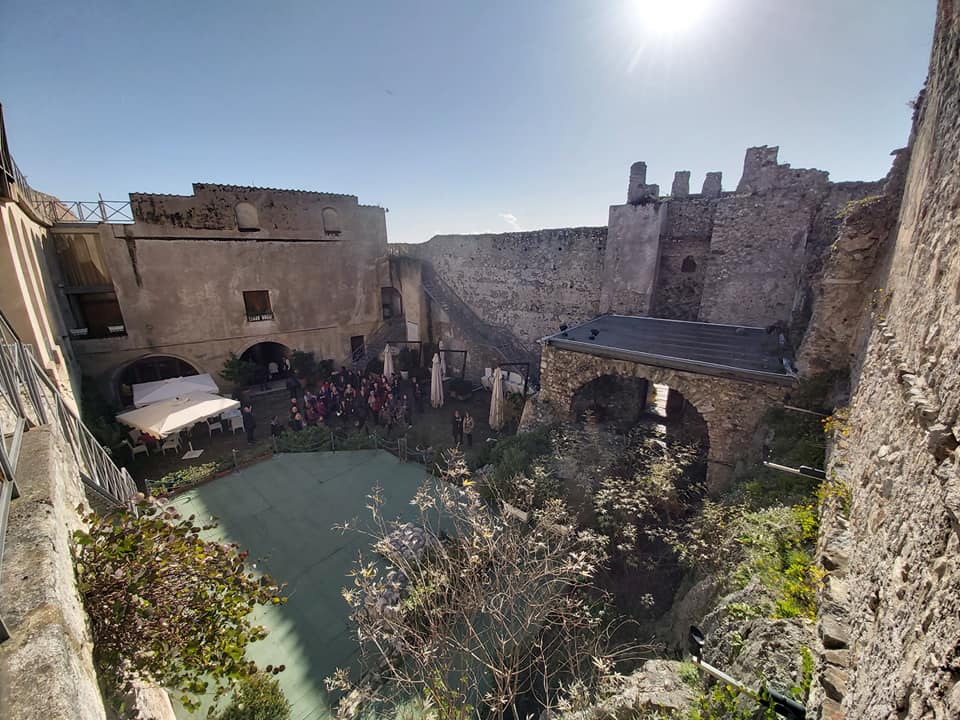
Arechi Castle dominates the city of Salerno from above and has been featured in all historical representations since the Middle Ages. From its terraces there is a spectacular panorama and one of the best views of the Gulf.

Official website

  • Description
  • Event
  • News
  • Gallery
  • Contacts
  • Map
  • Opening hours
  • Itineraries

Descrizione estesa
Historical background


The castle known as ‘of Arechi’ is located at a height of about 300 meters above sea level, on Bonadies Hill. It was built around the VIth century by the Byzantines, who probably expanded an already existing ancient Roman castrum.

.

In the 8th century the Lombard prince Arechi II, from whom the fortress takes its name, In the 8th century the Lombard prince Arechi the Second, from whom the fortress takes its name, decided to move his court to Salerno and expanded its defense system, starting from the castle a mighty wall that encircled the entire city from the hill to the sea. For centuries the ancient building maintained its defensive function, undergoing new modifications in the Norman, Angevin and Aragonese eras, during which it reached its maximum development.

The castle was built in the Middle Ages.

The structure underwent its last transformations in the 16th century, before its defensive needs came to an end.

The castle was used as a temporary residence by the Sanseverino princes, feudal lords of Salerno, and with time, lost its importance until it was almost completely abandoned with the’Unification of Italy.

In the 1960s the Province of Salerno purchased the castle from its last owners, initiating lengthy and complex restoration work and allowing new excavation activities to take place. Since the ’1980s, the’entire complex began to be returned to the public, leading to its complete reopening in the 2000s.


The Castle Today

The current configuration dates back to the sixteenth century, when the last functional changes were made, before defensive needs changed and the castle gradually lost its importance.

Today, the fortress preserves the architectural traces of the different periods in which it was featured. Made of local dark stone blocks, it has a central structure and a series of enclosures or compartments, which allowed the complex’s defense possibilities to be increased. Also part of the castle’s defensive system was theTurret, a massive, square-plan construction overlooking the sea to the east of the city. Slightly higher up, on a rocky outcrop above the castle, is the tower known as “The Bastille”, also part of the defense complex.

Since 2009, Arechi Castle has housed a medieval museum where numerous artifacts found during archaeological excavation and restoration campaigns conducted during the 20th century are on display. Prominent among the preserved materials is pottery, used for military purposes between the 9th and 11th centuries and later for civilian use. There is no shortage of glass artifacts and numerous metal objects traceable to the varied activities carried out in the castle, dating from the early Middle Ages to contemporary times.


To be discovered


  • The tower
  • .

The primitive layout of the tower, called in documents turris maior, raised about the middle of the sixth century by the Byzantines, is still partly recognizable today. It rose on the rock, developing over five or six floors. Its architecture was developed using the continuous wall perimeter and a series of piers that in turn supported the arches and vaults of the various floors

  • The Bastille

The Normans were most likely responsible for the construction north of the Bonadies summit, on a rocky outcrop, of the Bastille, a veritable control tower. Consisting of a single room, it could be accessed only with the use of ladders or other removable tools, due to the obvious difference in height from the ground level of the outer countryside.

    The tower was built by the Normans.

    • Ceramics and glass
    • .

    Archaeological excavations conducted in the castle have unearthed numerous fragments of “red-banded” pottery, characterized by decoration with narrow spirals or wide bands describing consecutive arches, protomaiolica pottery, characterized by glaze coating, and graffito pottery. Some glass goblets, whose coloring ranges between green and blue, date from around 1200.


    Curiosities / Need to Know

    .


    • A Roman castrum
    • .

    It was probably the inhabitants of the Roman colony of Salernum who first built a real military garrison on Bonadies Hill, whose main function was to control and “keep at bay” the threat of the Picentines, a local population ready to rebel against the predominant power of Rome.

    • A prince and a monk
    • .

    Arechi II, duke of Benevento and prince of Salerno, was a true patron to many men of culture of his time, including Paul Deacon, a Lombard monk and writer, author of the Historia Langobardorum. The work, written in Latin, consisted of six books and narrated the history of the Lombard people from their origins to the death of King Liutprand in 744.

    • A sport from another time
    • .

    In medieval times a popular sport was hunting, especially popular with lords and princes, who owned horses and dogs trained to sniff out and track prey. A widespread practice was hunting with hawks, which were trained both in low flight, to bring down prey by stealth, and in high flight, to precisely bring down prey from above. Hence originated the art of falconry still practiced today by experienced falconers.

     

Loading…

There is no news for this venue yet.

Phone
+39 089 227237


Web Site

facebook.com

Open in Maps

Orari di apertura
Day Morning Afternoon
Monday not accessible not accessible
Tuesday 09:00 – – – – 17:00
Wednesday 09:00 – – – – 17:00
Thursday 09:00 – – – – 17:00
Friday 09:00 – – – – 17:00
Saturday 09:00 – – – – 17:00
Sunday 09:00 – – – – 15:00
  • Cost: 4 €
  • Reduced Cost: 2 € (EU citizens 18-25 years old; groups of more than 15 people; state school teachers with permanent assignment
  • Free Ticket for the categories listed below:.
    • European Union citizens under the age of 18 or over 65 (visitors under the age of 12 must be accompanied)
    • .

    • Tourist interpreters from the European Union, when their work alongside the guide is needed (by showing valid license issued by the competent authorities)
    • Members of ICOM (International Council of museum)
    • .

    • Tourist guides from the’European Union in the exercise of their profession (by showing valid license issued by the competent authorities)
    • Groups or groups of students from public or private schools in the European Union, accompanied by their teachers, with prior reservation
    • Students enrolled in the faculties of Architecture, Preservation of Cultural Heritage, Education Sciences, Literary subjects with an archaeological focus and Letters and Philosophy with a historical-artistic focus, Academy of Fine Arts or corresponding faculties and courses in the menber states of the European Union (by showing the certificate of enrollment for the current academic year)
    • Disabled persons and their accompanying personnel who prove their membership in social and health care services
    • Operators of associations that carry out activities for the promotion and dissemination of knowledge of cultural heritage, based on agreements with the province of Salerno and the Ministry of Cultural Heritage and Activities
    • Teachers of art history (by showing appropriate document)
    • .

    • Journalists in good standing with the payment of membership dues (by exhibiting suitable document proving the’professional activity carried out)
    • For reasons of study or research attested by educational or university institutions, Italian and foreign research and cultural institutes, as well as Mibac
    • bodies

    • Provincial employees and their cohabiting family members (spouses and children)
    • .

Social networks:
Facebook: Provincial Museums Salerno


ITINERARI
  • Salerno by Bike between Sea and Mountains
  • Salerno outdoor experiences – Map
  • The Grand Tour and Salerno
  • Salerno longobarda
Releted contents
Provincial Archaeological MuseumSalerno's Provincial Archaeological Museum is a must-see for anyone who wants to…
Diocesan Museum St. MatthewThe Diocesan Museum 'San Matteo' preserves one of the richest cultural heritages…
Provincial Art GalleryThe Pinacoteca Provinciale houses one of the most important art collections in…
Minerva GardenMinerva's Garden is a beautiful green oasis in the heart of the…
Creative City MuseumThe Creative City Museum was created to highlight the past and present…
Virtual Museum Salerno Medical SchoolThe Virtual Museum of the Salerno Medical School tells the story of…
Roberto Papi MuseumThe 'Roberto Papi' Medical-Surgical Museum is a truly unique place. Located in…
Portanova Square and the RotundaPortanova Square is the entrance to the Historic Center. The gate, rebuilt…

Comune di Salerno
Via Roma – Palazzo di Città, 84121 Salerno
C.F. 80000330656 P.IVA 00263650657
Email: cultura@comune.salerno.it

Esplora Luoghi

  • Itinerari
  • Teatri e Spazi Culturali
  • Architettura Moderna
  • Musei e Archeologia
  • Palazzi e Piazze
  • Chiese e Monasteri
  • Giardini e Parchi

Eventi

  • Teatro
  • Concerti
  • Danza
  • Fiere
  • Manifestazioni
  • Mostre
  • Musica
  • Opera
  • Prosa
  • Rassegne

Salerno

  • Personaggi
  • Museo civico
  • Navi da Crociera 2025
  • Come Arrivare
  • Muoversi
  • Contesto e dintorni
  • Media Gallery
  • Progetti
  • Link Utili
  • Contattaci

© 2026 Comune di Salerno – Tutti i diritti riservati

  • Credits
  • Privacy Policy
  • Cookie Policy