• Home
  • Explore places
    • Itinerary
    • Verdi Theater
      • Home Verdi Theater
      • The season
      • Ticket office
      • Guided Tours Verdi Theater
    • Cultural Venues and Theatres
    • Churches and Monasteries
    • Palaces and Squares
    • Museums and Archaeology
    • Gardens and Parks
    • Modern Architecture
  • Events
    • Find an Event
    • Artist Lights
    • Must‑see events in Salerno
    • Featured Events
    • Events L'evento inizierà tra 167 giorniSan Matteo fest Free admission 21 Sep 2026
  • News
  • Salerno
    • historicals Figures
    • History of Salerno
    • The city
    • Civic Museum
    • Food and Wine
    • Traditions
    • Context and surroundings
    • How to get there
    • Cruise Ships 2026
    • Move
    • Useful Links
    • Contact us
  • Projects
  • English
    • English
    • Italiano
    • Français
Salerno Cultura -
  • Home
  • Explore places
    • Itinerary
    • Verdi Theater
      • Home Verdi Theater
      • The season
      • Ticket office
      • Guided Tours Verdi Theater
    • Cultural Venues and Theatres
    • Churches and Monasteries
    • Palaces and Squares
    • Museums and Archaeology
    • Gardens and Parks
    • Modern Architecture
  • Events
    • Find an Event
    • Artist Lights
    • Must‑see events in Salerno
    • Featured Events
    • Events L'evento inizierà tra 167 giorniSan Matteo fest Free admission 21 Sep 2026
  • News
  • Salerno
    • historicals Figures
    • History of Salerno
    • The city
    • Civic Museum
    • Food and Wine
    • Traditions
    • Context and surroundings
    • How to get there
    • Cruise Ships 2026
    • Move
    • Useful Links
    • Contact us
  • Projects
  • English
    • English
    • Italiano
    • Français
Salerno Cultura -
  1. Home
  2. Explore places
  3. Palaces and Squares
  4. Fruscione Palace

Fruscione Palace

An excellent testament to the city’s complex and layered past, Palazzo Fruscione tells visitors about twenty centuries of Salerno’s history, traces of which can be seen in the recovered architecture and frescoes visible inside.


  • Description
  • Event
  • News
  • Gallery
  • Contacts
  • Map
  • Opening hours
  • Itineraries

Descrizione estesa

Between vicolo Adelberga and vicolo dei Barbuti, on the northern side of the Church of S. Pietro a Corte, stands thepalazzo known as “Fruscione”, from the surname of the last family that inhabited it and to which it was expropriated to make it public property.

Built in the mid-13th century, it was mistakenly called first a remnant of the Salerno residence of Arechi II, then “palace of the Norman princes.” The building, which has different archaeological layers, rests partially on the remains of aRoman bath complex, an extension of the nearby bath complex of S. Peter a Corte. Recent restoration work has unearthed elements of masonry, fragments of frescoes and an almost fully intact Roman mosaic, dating from the 1st-2nd centuries AD.

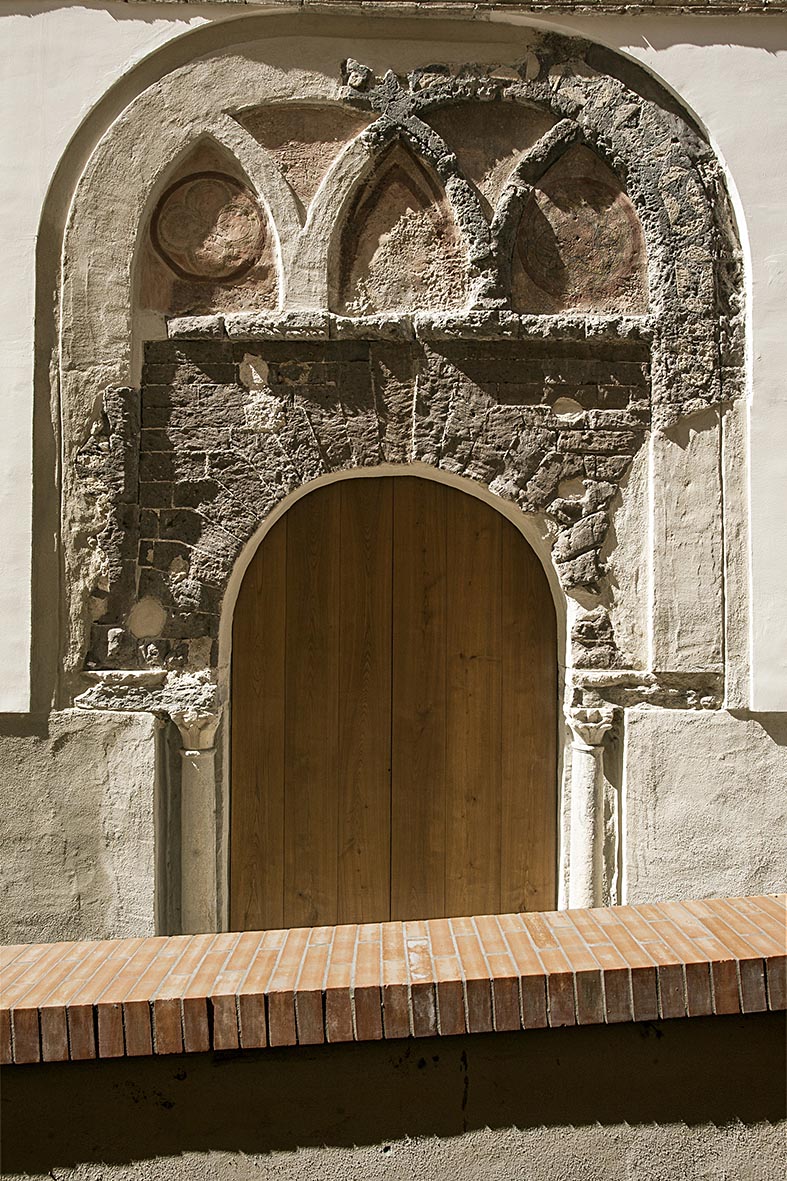
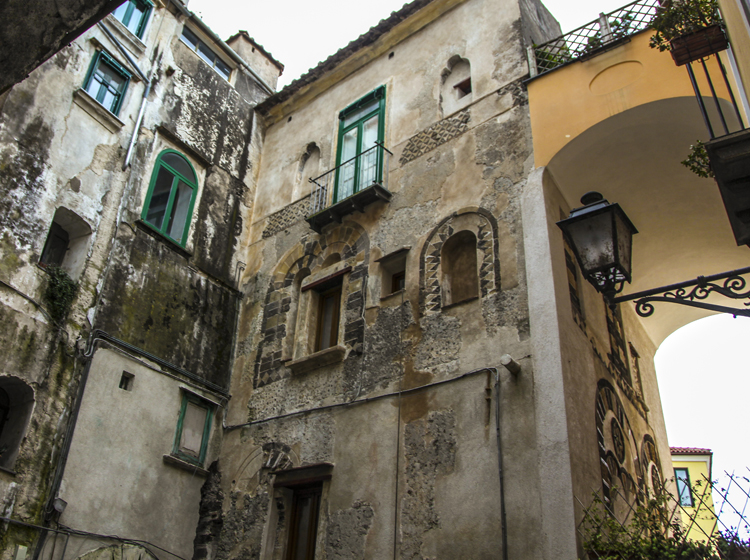
The yellow and gray tufa inlays on the facade suggest an even earlier origin of the palace, presumably referable to the Norman era. The three portals present on Vicolo dei Barbuti and the rooms on Vicolo Adelberga date back to the 13th century, when the palace underwent major renovations, while the second floor was added in the 14th century, during the Angevin period. During the seventeenth century, the ground floor was used as stables, as evidenced by a notarial document dated 1575 that places a ‘lodging house,’ a kind of hospice owned by the cathedral, inside the building.

The floor was used as a stable.

The eastern façade is adorned with fine architectural elements. On the ground floor can be seen three portals surmounted by round arches, on the second floor, five carved mullioned windows and on the second floor, a series of polyphores intertwined with pointed arches supported by small columns.

In 2013, the major structural renovation work conducted by the city government was completed with the goal of transforming the palace into a large cultural pole in the heart of the city’s historic center.

Loading…

There is no news for this venue yet.


Open in Maps

Orari di apertura

The palace can be visited during exhibitions and cultural events.


ITINERARI
  • Salerno Normandy
  • Ancient Salerno: between Etruscan and Romans
Releted contents
Arechi CastleArechi Castle dominates the city of Salerno from above and has been…
Portanova Square and the RotundaPortanova Square is the entrance to the Historic Center. The gate, rebuilt…
Abbot Conforti SquareAbate Conforti Square, the anti forum of the Roman city, is the…
State ArchivesIn an ancient palace that was the seat of the Royal Hearing,…
Terracena CastleCastel Terracena was the seat of Norman rule. Commissioned and built by…
Villa AveniaVilla Avenia is named after its former owner, Dr. Saverio Avenia, a…
Government PalaceThe Government Palace represents the stylistic evolution of Fascist-era architecture, now far…
City PalaceIn the 1930s, in full Fascist style, Palazzo di Città was built,…

Comune di Salerno
Via Roma – Palazzo di Città, 84121 Salerno
C.F. 80000330656 P.IVA 00263650657
Email: cultura@comune.salerno.it

Esplora Luoghi

  • Itinerari
  • Teatri e Spazi Culturali
  • Architettura Moderna
  • Musei e Archeologia
  • Palazzi e Piazze
  • Chiese e Monasteri
  • Giardini e Parchi

Eventi

  • Teatro
  • Concerti
  • Danza
  • Fiere
  • Manifestazioni
  • Mostre
  • Musica
  • Opera
  • Prosa
  • Rassegne

Salerno

  • Personaggi
  • Museo civico
  • Navi da Crociera 2025
  • Come Arrivare
  • Muoversi
  • Contesto e dintorni
  • Media Gallery
  • Progetti
  • Link Utili
  • Contattaci

© 2026 Comune di Salerno – Tutti i diritti riservati

  • Credits
  • Privacy Policy
  • Cookie Policy